Prepaid Packages for Salons and Barbershops: How to Sell and Track Them
Why prepaid packages change your salon's cash flow
You've been cutting the same loyal client's hair for three years. He comes in every 20 days, pays $40 and leaves happy. Great client. But the money only comes in when he sits in the chair, and if he disappears for two months, your register feels it.
Now picture selling that same client a bundle of 10 cuts paid all at once. You get paid right away, he's committed to coming back, and his return visits stop being a gamble. That's what prepaid packages solve for salons and barbershops: you know what's coming in each month and clients have a reason to come back, without you chasing the ones who drift away.
I'll show you how to put packages together, price them, sell them and (the part most people get wrong) track each client's balance without it turning into a mess of scribbled notes.
What a prepaid package is (and why it works)
It's simple: the client pays up front for a set of services and uses them over time. "10 cuts," "5 blowouts," "4 hair and beard sessions," "a bridal package with 3 trial runs." The balance is recorded and goes down with each visit.
The reason it works so well comes down to how clients think:
- Money already spent = a guaranteed return. Someone who paid for 10 cuts up front isn't going to a competitor. Their money is already with you.
- Cash today is worth more than cash tomorrow. Getting $360 now gives you breathing room to restock products or pay for a new chair without stretching.
- Fewer no-shows. A client with a balance on the books has a concrete reason to show up.
- Bigger ticket per visit. Someone who already bought the package for the main service is more likely to add a beard trim, brows or a product at the counter. I cover this in more detail in how to increase the average ticket at your barbershop.
A prepaid package is a close cousin of a loyalty program, with one important difference: here the client pays first. Real commitment.
How to price packages without losing money
This is where the most common mistake lives. The owner thinks "I'll give 10 cuts for the price of 8" without running the numbers, then finds out later that they handed out hours of work for free.
The right logic: the package discount has to be smaller than what you save or gain by having the client locked in. You're not selling cheap. You're buying predictability and loyalty. Pay a fair price for that, not an inflated one.
A practical way to get to the number
- Start with the full price. Say a single cut is $40. Ten cuts = $400.
- Set the discount based on the commitment. The bigger the package and the longer the term, the more discount makes sense. Somewhere between 8% and 15% usually strikes a good balance. On a 10-cut package, a 10% discount puts the bundle at $360, or $36 per cut.
- Check your margin. If your cost per cut (product, the professional's commission, overhead) is $22, you still keep $14 in margin per visit on the package. Healthy. If the commission is high and the margin would get tight, cut the discount or make the package bigger.
- Test before rolling it out. Launch one package, see if it sells, adjust. You don't need ten bundles on day one.
A table helps you see the trade-off (illustrative figures):
| Package size | Full price | Discount | Package price | Paid |
|---|---|---|---|---|
| 5 cuts | $200 | 8% | $184 | Up front |
| 10 cuts | $400 | 10% | $360 | Up front |
| Cut + beard (8x) | $400 | 12% | $352 | Up front |
The numbers above are examples. Swap in your own prices and your real margin. The point is the structure, not the cents.
Set an expiration date
A package with no deadline becomes a liability forever. A client disappears for a year and comes back asking for 6 cuts you had already counted as revenue. Set an expiration date (6 months for a 10-visit package is usually reasonable) and make it clear at the time of sale. It protects you and keeps your cash flow organized.
How to sell the package without being pushy
The best moment to offer it isn't in a random campaign. It's in the chair, with a happy client, right after a cut that came out great. "Man, you're here like clockwork every month. Grab a 10-cut package, it's 10% cheaper and you don't have to pay every time." In that moment, the offer makes sense to him.
A package sold is a client who has already decided to come back, and that's where retention starts. If you want to build this out more broadly, read Barbershop Client Retention: 9 Strategies That Work and, for salons, Salon Loyalty Program: How to Build One That Works.
A few triggers that work at the front desk:
- Proven regulars. Offer it to people who already come all the time. The sale is almost automatic.
- Ongoing maintenance services. Beard, blowouts, keratin smoothing, nails. Anything clients repeat on a cycle is a perfect package candidate.
- Peak seasons. Before the holidays, clients are happy to pay ahead to secure their slots.
- Referrals. "Buy the package and get a free cut to bring a friend." You sell a package and win a new client in one move.
What about payment? An online payment link (card) sent right in the chat handles most sales. If your card provider offers installments, that can also unlock the client who wants a bigger bundle but doesn't have the full amount right now.
After the sale comes the hard part: tracking the balance
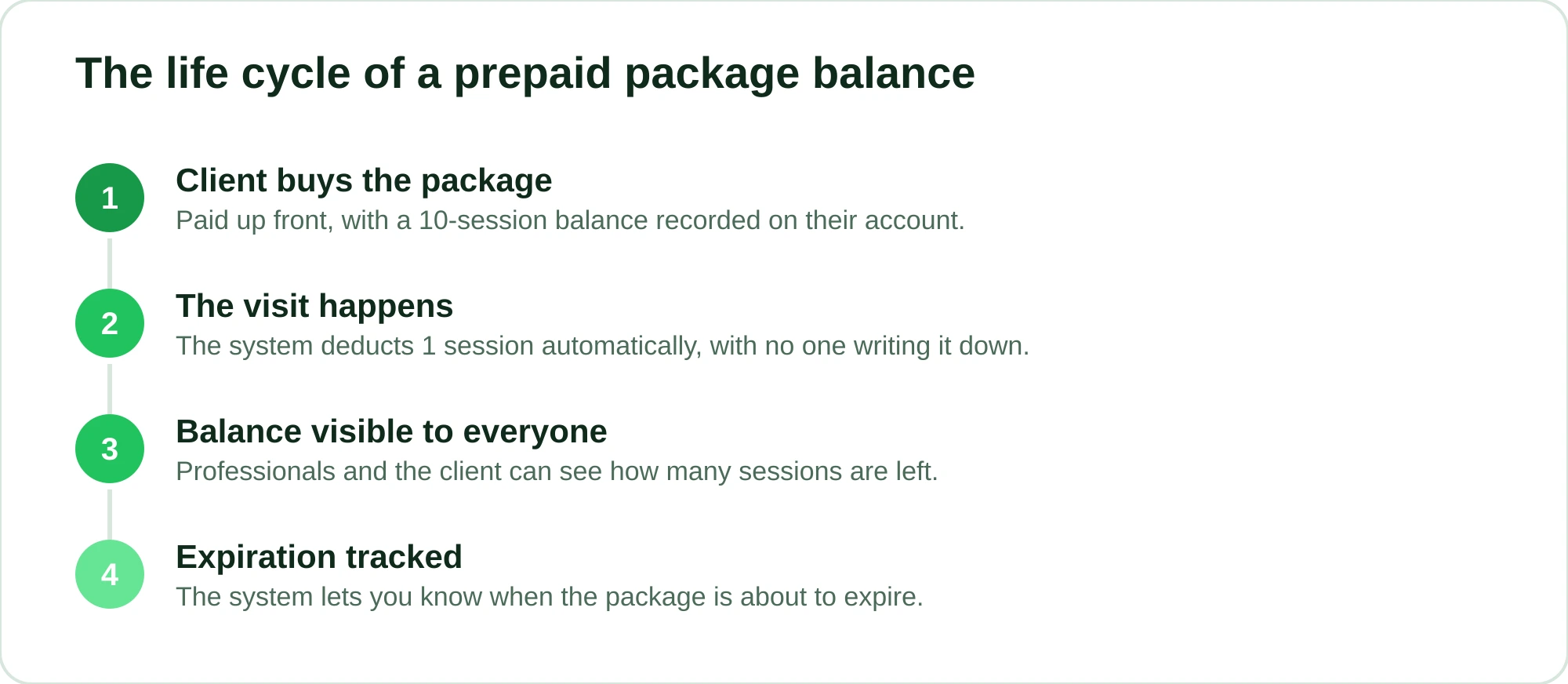
Selling is the easy part. The nightmare starts when you have 30 clients with active packages and need to remember how many cuts each one has used.
The notebook method falls apart fast. The page gets wet, the client swears they have 4 left when they have 2, two different professionals see the same person and neither knows the real balance. You end up losing money to disorganization or, worse, creating friction with a good client over a count nobody wrote down properly.
That's when a system with package tracking makes the difference. In RobotiZap, each client's package balance is recorded and a session is deducted automatically at every visit. The professional sees how many sessions are left before starting. The client can even check on WhatsApp. No more arguments at the front desk.
And since RobotiZap is already the assistant that books on WhatsApp 24/7, everything connects: the client books the appointment, uses a session from the package, gets an automatic reminder before coming in and can even pay through an online payment link (card) right in WhatsApp, with no app to download and no sign-up. The assistant runs in step-by-step mode (a menu) or AI mode, which understands free text and even voice messages from clients.
Because it runs on the official WhatsApp API (we're a Meta-certified Tech Provider), you get package tracking without risking your business number on an unofficial tool that keeps getting banned.
What to look for in good package tracking
- Automatic balance. It deducts on its own at every visit, with no one writing anything down.
- Visible to every professional. Several professionals, one schedule, the same balance for everyone. (There's a post on this: Scheduling for Multiple Professionals: One Calendar, No Mix-Ups.)
- Expiration tracking. The system lets you know when a package is about to expire.
- Client history. You see who bought, who used everything and who is close to renewing, which is the perfect cue to offer the next bundle.
What it's worth in practice
Add up what the problem costs you. A forgotten package here, a client who disappeared with a balance there, half an hour a week wrestling with the notebook. Put it all together over a month and the hidden loss weighs more than it seems.
That's where RobotiZap comes in. RobotiZap has a single plan, with unlimited bookings and professionals, and package tracking, automatic reminders, deposit collection, loyalty points and conversational AI are all included. No per-professional fees, no long-term contract.
You can start a free trial: create your RobotiZap account, set up a package and watch the balance go down on its own at the first visit. If it doesn't fit your business, just don't continue.
Frequently asked questions
What's the ideal discount on a prepaid package?
It depends on your margin, but somewhere between 8% and 15% usually works. The key is that the discount should be smaller than what you gain by locking in the client and getting paid up front. Work out your margin per visit before deciding, because a package that's too cheap is free work.
How do I track how many sessions a client has used?
A notebook or spreadsheet works for a handful of sales, then turns into a source of mistakes and arguments. Ideally you want a system that deducts the balance automatically at every visit and shows it to every professional. In RobotiZap this is automatic, and clients can check their balance on WhatsApp.
Should a prepaid package have an expiration date?
Yes, it's recommended. Without a deadline, the package becomes a liability that can come back at any time and throw off your cash flow. Set a reasonable expiration, for example 6 months for a 10-session package, and make it clear at the time of sale. Also check your local consumer rules on package expiration before you set one.
Can clients pay for a package in installments?
That depends on your card provider. An online payment link (card) handles most up-front sales, and if installments are available to you, offering them can unlock the client who wants a bigger bundle without having the full amount right away. In RobotiZap, the client pays right in WhatsApp through an online payment link (card).
Is a prepaid package the same as a loyalty program?
They're related, but different. With a package, the client pays up front for a set of services, which is a financial commitment. With a loyalty program, they collect points or perks over time. The two complement each other, and you can run both with the same client.