Salon Loyalty Program: How to Build One That Works
Why a salon loyalty program works (when it's done right)
A good salon loyalty program rewards clients for coming back before they think about trying the salon across the street. That's the whole idea. The problem is that most paper "buy 10, get 1 free" cards don't keep anyone: they get lost in a wallet, get wet, get lost again, and in the end you give a free service to someone who would have come back anyway.
You can do better. And you can do it without wrecking your margin.
I'll show you how to build a program that rewards the behavior that matters (coming back often, spending more per visit, bringing a friend), how to set the points rule without guessing, and how to automate everything on WhatsApp so you don't end up counting points at the register.
First things first: what do you want the client to do?
A loyalty program is there to encourage a specific behavior, not to hand out freebies. So first decide what you want to change at your salon.
Common cases at the front desk:
- A client who comes in now and then and you want her to come monthly.
- A client who only books one service (a cut) and you want her to try another (color, deep conditioning).
- A reliable, high-value client you want to protect from the competition.
- Empty chairs on Tuesday and Wednesday that you need to fill.
Each of these calls for a different rule. A generic program doesn't solve any of them properly. If your biggest problem is clients disappearing, loyalty may not even be the first step. Read How to win back inactive clients on WhatsApp first, because bringing back someone who drifted away is usually cheaper than winning a new client.
Points rules: how to set them without guessing
The points rule is the heart of the program. Get it wrong and either the numbers don't work or you create a reward nobody reaches.
Points per amount spent (the simplest and fairest)
The cleanest approach is to award points per dollar spent. For example: 1 point for every $1 spent. The reward unlocks once she collects X points.
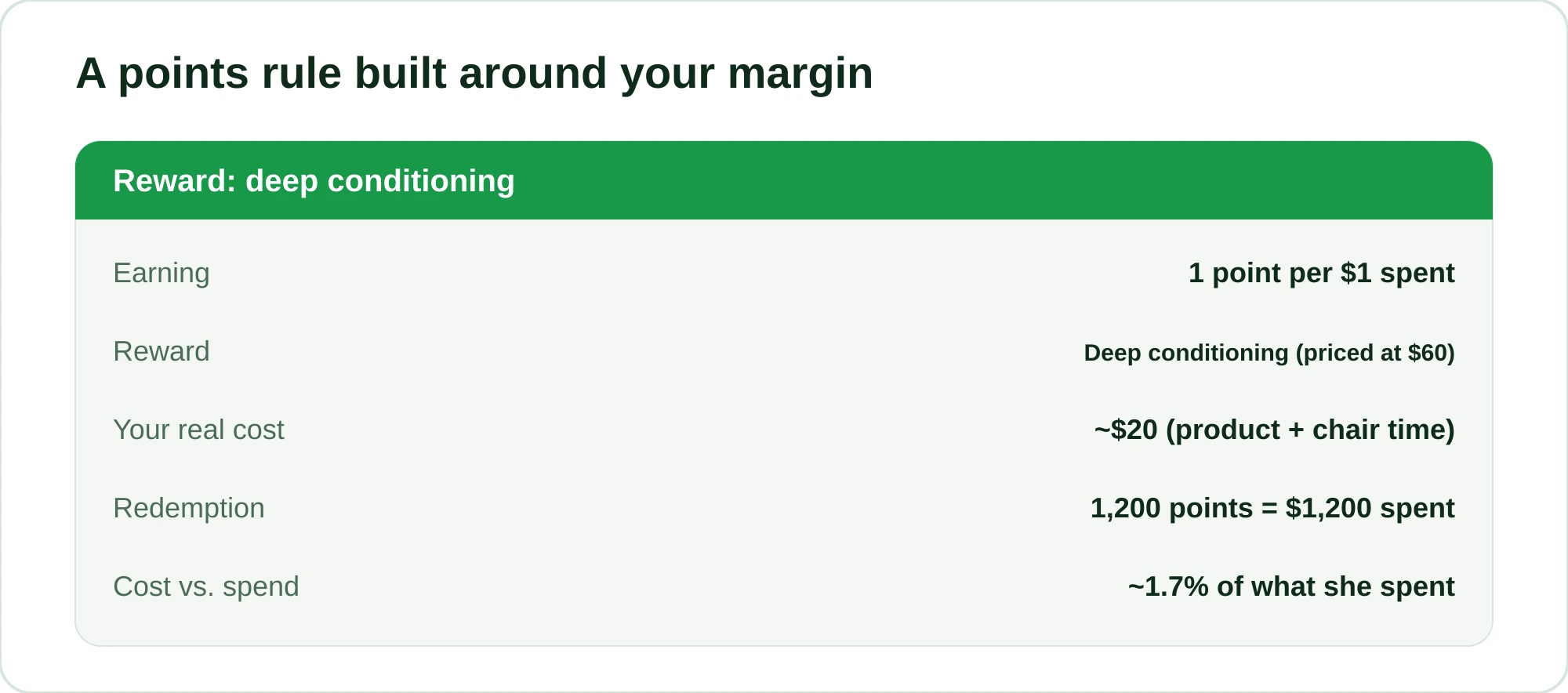
The right question isn't "how many points do I give?" but "how much of my margin am I willing to give back?" If your goal is to give back at most 5% in rewards, the math looks like this (illustrative figures):
| Item | Value |
|---|---|
| Client earns | 1 point per $1 |
| Reward | Deep conditioning treatment priced at $60 (your real cost: ~$20) |
| Points to redeem | 1,200 points ($1,200 spent) |
| Reward cost vs. spend | ~1.7% of what she spent at your salon |
Notice one detail: the reward is "worth" $60 to the client, but it only costs you the product and the chair time, not the full $60. That's why rewarding with a service usually beats giving a cash discount. A discount comes 100% out of your pocket. A service only costs you what it costs to deliver.
Points per visit (to drive return visits)
If your goal is frequency, award points per visit, not per amount. For example, every visit within the same month earns double points. Someone who waits three months to come back earns slowly; someone who comes every month unlocks rewards fast. This ties in directly with recurring appointments, another way to secure return visits without relying on the client's memory.
Watch out for rewards that are too easy (or too hard)
A reward that's too easy becomes a fixed cost: you're giving free services to clients who were already loyal. A reward that's too hard is one nobody reaches, and the program dies because nobody believes in it. The sweet spot is a reward the client sees as reachable in 3 to 5 visits: close enough to be worth it, far enough to change behavior.
What to reward (and what never to reward)
Good rewards for a salon:
- A low-cost service with high perceived value: deep conditioning, eyebrow shaping, a blowout. It costs you little and means a lot to her.
- An upgrade: she booked a cut and gets a blowout with it. You fill chair time that would have been empty anyway.
- A retail product: a shampoo, a styling cream. It costs you the wholesale price, not the retail price.
- Priority booking on busy dates. Zero cost, high value for a loyal client.
What to avoid:
- Cash or straight discounts: they eat into your margin and teach the client to come back only when there's a discount.
- Rewarding your most expensive, longest service, which ties up your chair for hours on an appointment that brings in nothing.
- Points that never expire: points that last forever become a liability. Set an expiry (6 to 12 months), which also gives you a reason to send a "your points expire soon" message.
Loyalty is only one part of the relationship. Other things go hand in hand with it: service, reminders, a birthday treat. If you want the full picture, these 9 client retention strategies work for salons too, not just barbershops.
How to automate points (without a notebook)
Tracking points is where most salons give up within two weeks. Tracking points by hand isn't sustainable: nobody is going to keep adding up points and checking balances from memory. Clients lose paper cards. You forget to update the spreadsheet.
The program has to run on its own, and that's what RobotiZap does.
RobotiZap is the WhatsApp assistant that books appointments on its own, 24 hours a day, and it has built-in points-based loyalty. Here's how it works in practice:
- The client books on WhatsApp, with no app to download and no sign-up. She can choose between a step-by-step menu or chatting with the AI in free text or even voice messages.
- Every completed appointment adds points automatically to her profile.
- The client checks her own balance on WhatsApp whenever she wants.
- When she gets close to a reward, you can let her know, and that brings people back to the salon without you lifting a finger.
Because RobotiZap runs on the official WhatsApp API (RobotiZap is a Meta-certified Tech Provider), these messages go out safely, without the ban risk that comes with mass messaging from a regular number.
And it doesn't stop at loyalty. The same assistant manages the schedules of multiple professionals at once, sends automatic reminders to reduce no-shows, asks for a review after the appointment and even tracks prepaid packages, which are close cousins of loyalty: the client prepays a package of 4 blowouts, she's already committed to coming back, and you get paid upfront.
Loyalty points vs. prepaid packages: which to use?
Both tools keep clients coming back, but in different ways. It's worth understanding the difference so you don't use one when the situation called for the other.
- Points program: rewards people who are already regular clients. Money comes in as usual and the reward comes later. Good for rewarding volume and frequency over time.
- Prepaid package: the client pays upfront for a block of services. It brings in cash right away and guarantees the return visits. Good for recurring services (blowouts, nail maintenance, root touch-ups).
In practice the two work well together: the package locks in the recurring visits of clients who have already decided, and points reward everything else. You can run both through the same assistant.
Mistakes that cost you money (and how to avoid them)
- Rewarding with something that takes a lot of work and brings in little. A good reward costs you little and feels like a lot to her.
- Not setting an expiry on points. Without one, the liability piles up and you never know how much you owe in rewards.
- Making the rule confusing. If the client doesn't understand how she earns, the program won't change any behavior. A points rule should fit in one sentence.
- Tracking it by hand. You'll get tired, get balances wrong and end up in arguments at the register. Automate it or don't start.
- Mixing loyalty with desperate discounts. If you already give everyone 20% off, points become just one more cost on top.
What it costs to run this
This is where a lot of owners hesitate: "am I going to pay for software just to track points?" It's not just for that.
RobotiZap has a single plan, with unlimited bookings and professionals, a free trial and no long-term contract. The plan includes the assistant that books 24/7, the AI that understands text and voice messages, reminders that cut no-shows, points tracking, packages, professional commissions and post-appointment reviews.
Look at what it gives back, not just the monthly fee: the no-shows it prevents, the clients who come back sooner because of a points-expiring reminder, and the hours you no longer spend answering "any openings tomorrow?" and adding up points by hand.
Compared with empty chairs and clients who moved to the competing salon, an automated loyalty program is one of the cheapest investments you can make.
Start your loyalty program today
Set the rule (1 point per dollar or per visit), pick 2 or 3 low-cost, high-perceived-value rewards, set an expiry on points and let automation handle the rest.
You can try everything with the free trial: create your RobotiZap account and set up your salon's loyalty program this week. If you'd like to see all the features first, take a look at robotizap.com.
Frequently asked questions
How does a points program work at a beauty salon?
The client earns points with every appointment or every dollar spent and redeems them for a reward once she has enough. The simplest and fairest rule is to award points per amount spent (for example, 1 point per $1) and reward with a low-cost, high-perceived-value service such as deep conditioning or eyebrow shaping. With an assistant like RobotiZap, points add up automatically with every completed service and the client checks her balance right on WhatsApp.
What's the best reward for a salon loyalty program?
The best reward costs you little and is highly valued by the client: a quick service (blowout, deep conditioning), an upgrade on an appointment she has already booked, or a retail product at cost. Avoid cash discounts: they come 100% out of your pocket and teach the client to come back only when there's a promotion.
How do I keep a loyalty program from losing money?
First decide how much of your margin you're willing to give back (5% is a healthy ceiling) and design the points rule from there. Reward with services at cost, not with cash. Set an expiry on points (6 to 12 months) so you don't build up a never-ending liability. And automate tracking, because balance mistakes made by hand turn into losses and arguments at the register.
Can I track loyalty points on WhatsApp?
Yes. RobotiZap adds points automatically after every completed appointment, and the client checks her balance on WhatsApp, with no app to download and no sign-up. Because it runs on the official WhatsApp API (Meta-certified Tech Provider), points notifications go out safely without the risk of a ban.
Loyalty points or prepaid packages: which sells more?
It depends on your goal. Prepaid packages bring in cash right away and guarantee return visits, which is great for recurring services like blowouts and nail maintenance. A points program rewards frequency and volume over time. The two work well together and can run on the same assistant, so you don't have to pick just one.