Barbershop Client Retention: 9 Strategies That Work
Barbershop client retention without competing on price alone
Barbershop client retention starts with simple math: the guy who has been getting his cut with you every month for two years spends far more than the discount you offer to attract a new face on Instagram. And he brings his brother, his coworker and his 8-year-old son.
Even so, most barbershops pour their energy into chasing new clients and let the old ones slip away without noticing. A regular disappeared? Nobody called. Hasn't been in for three months? Nobody noticed. Then he finds another barbershop closer to home and that's it: you lost a chair that used to be a sure thing.
Retention means making the client feel that coming back to you is less work than finding somewhere else. A freebie on its own won't keep anyone. Below are 9 things you can start doing at the front desk this week, no big-chain budget required.
1. Know every client's cut (and prove you remember)
Nothing builds loyalty like a barber who looks at a client and says, "number 2 on the sides, scissors on top, same as last time?" The guy relaxes right away. He doesn't have to explain everything again or hope it turns out fine.
The problem is you can't keep that in your head for 300 clients. Write it down. A notebook works, but ideally you keep a client profile with their cut history, preferences and even the pomade brand they like. When bookings go through a system, that history is saved automatically and any barber on the team can serve the client like his usual barber would.
2. Build a real points program
The paper punch card works, but it gets lost, wet, torn, and the client leaves it at home. A digital loyalty program fixes that: every cut earns points, and the client redeems them for a discount, an extra service or a product.
The rule needs to be clear and easy to understand. For example:
- 1 point for every $1 spent.
- 200 points become $20 off, or a free eyebrow cleanup.
- No fine print, no short deadline to use them.
Points make the client think twice before getting a cut somewhere else, because switching barbershops means "losing" what he has already earned. With RobotiZap you set up points-based loyalty and the client checks his own balance on WhatsApp, with nothing for you to track by hand.
3. Send the return reminder at the right time
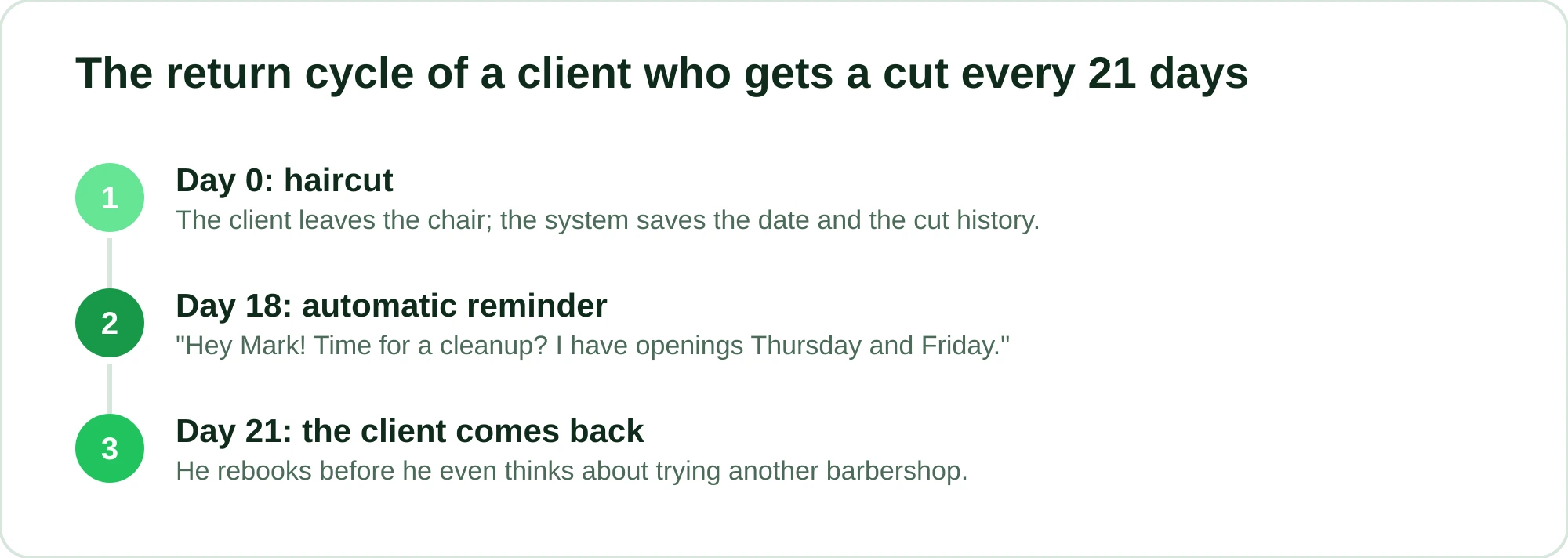
This is the one most people forget to use. Anyone who gets haircuts has a cycle: 15, 20, 30 days. If you know Mark gets a cut every 21 days, why wait for him to remember?
An automatic reminder on day 18 or 19 ("Hey Mark! Time for a cleanup? I have openings Thursday and Friday") brings the client back before he lets his hair grow out and thinks, "eh, I'll go next week." And next week turns into a month.
This is different from the confirmation reminder for an appointment that's already booked. It's a rebooking reminder, based on his history of when he usually comes back. Doing it by hand is impossible to keep up with; automated, it runs on its own and fills your schedule with people who are already your clients.
4. Don't let a missing client become a lost client
Everyone has that list of people who used to be regulars and stopped coming. They moved, were short on cash one month, tried another barbershop. A good share of them come back with a little nudge, as long as the nudge arrives before they get used to getting their cut somewhere else.
An honest message works better than an aggressive promotion: "Hey stranger! Haven't seen you around in a while. Want to book a cut? I can fit you in this week if you like." No drama, no desperate discount.
Setting this up by hand is a lot of work and you never remember to do it. That's why it's worth reading How to win back inactive clients on WhatsApp, where I explain how to spot who has gone missing and what to send to bring them back without sounding pushy.
5. Sell prepaid packages
Packages give you retention and cash flow in one move. The client buys 5 cuts upfront at a slightly better price than paying one at a time. The result: he's already committed to coming back 5 times, and you get the money today.
Someone who bought a package rarely switches barbershops halfway through. After all, he has already paid. And every package visit is another chance for him to buy a pomade, add a beard trim or bring a friend.
The catch is tracking: how many cuts are left, the expiry date, who used what. On paper it gets messy fast. For a step-by-step guide on selling and tracking packages without getting tangled up, see Prepaid salon packages: how to sell and track them.
6. Make booking so easy that finding another place feels like more work than coming back
A loyal client is one for whom booking with you takes no effort at all. If he has to call during the rush, wait for you to put down the scissors to reply, or send a message and hear nothing until evening, every booking becomes a small friction point. And friction pushes clients toward the competitor who replies right away.
The bottleneck here is responding. You can't stop a cut to answer WhatsApp, and at night at home the last thing you want to do is book appointments. A virtual assistant that books on its own, 24 hours a day, solves this: the client messages at 11 pm, picks the service, the professional and the time, and he's booked, without you touching your phone.
RobotiZap does exactly that on WhatsApp, with no app for the client to download and no sign-up. It works in two modes: a step-by-step menu for people who like to tap, or conversational AI that understands free text and even voice messages. The client sends "I want to book a cut and beard trim for Saturday morning" and the assistant handles it. The less friction there is to book, the more often the client comes back.
7. Reduce no-shows (because no-shows drive clients away too)
It sounds counterintuitive, but no-shows hurt retention on both sides. When a client doesn't show up without warning, you lose the slot. When you let your schedule get messy and run half an hour late, your best client is the first to get annoyed and look for a better-organized shop.
An automatic confirmation reminder the day before greatly reduces the number of no-shows. And for the most sought-after slots, asking for an upfront deposit through an online payment link (card) makes the client think twice before bailing. If you want to dig deeper, see the guide on how to reduce no-shows at your salon or barbershop.
8. Ask for reviews and show that you listened
After the cut, sending a quick "hey, how did it turn out?" does two things. It shows that you care, and it gives you an early warning when something didn't land, before the client simply disappears without ever saying why.
When you get a compliment, ask him to leave a Google review. When you get a complaint, fix it quickly and in a private message. A client who complained and was treated well is often more loyal than one who never had a problem. Automatic post-appointment reviews save you from having to remember to ask every time.
9. Raise the value of every visit without pushing sales
A loyal client comes back. A loyal client who is well looked after comes back and spends a little more each visit, without feeling pushed. Offer the beard trim with the cut, suggest the pomade he already uses, remind him about the combo. Done naturally, this raises your average ticket and improves the experience at the same time. There's a whole article on this in How to increase the average ticket at your barbershop.
What it costs compared to what you lose by not doing it
You can run all of this with a notebook and your memory. But honestly, nobody can remember the haircut cycle of 300 clients, track points on paper and message people one by one. Whatever isn't automatic simply doesn't happen in the daily rush of a barbershop.
| What builds loyalty | By hand | Automated |
|---|---|---|
| Return reminder | You forget | Goes out on its own on each client's cycle |
| Loyalty points | A card that gets lost | Balance on the client's WhatsApp |
| Winning back missing clients | Almost never happens | A list spots them and sends the message |
| Cut history | The barber's memory | A profile saved for the whole team |
| 24/7 booking | You reply when you can | The virtual assistant books on its own |
RobotiZap runs all of this on a single plan, with unlimited bookings and professionals. Every prevented no-show and every client you win back is a chair that stays full, and on top of that you get back the hours you used to spend on WhatsApp replies, with the AI answering for you. And because it uses the official WhatsApp API as a Meta-certified Tech Provider, you also stay clear of the ban risk that a regular number runs.
You can try it with a free trial and no long-term contract at app.robotizap.com/register. Turn on the virtual assistant, set up points and return reminders, and watch your schedule fill up on its own with people who are already your clients.
Frequently asked questions
How do I get clients to come back to my barbershop more often?
The most effective approach is to make rebooking easy and use return reminders based on each client's cycle. Someone who gets a cut every 20 days should get a nudge around day 18, before he considers going elsewhere. Add loyalty points and prepaid packages, which give him a concrete reason to stick with you.
Is a loyalty program worth it for a small barbershop?
Yes, and that may be where it makes the biggest difference. A small barbershop depends on its regulars, and losing even a few already hurts the bottom line. A digital points program is cheap to run and gives the client one more reason not to switch barbershops. What matters is keeping the rule simple and delivering what you promised.
Do paper loyalty cards still work?
They work, but they fall far short of digital. A paper card gets lost or wet, or the client leaves it at home, so retention depends on his memory. In digital form, the balance is saved and the client checks it on WhatsApp, with no chance of losing track.
How long does it take to see results from a retention strategy?
Return reminders and win-back messages to inactive clients usually bring people back within the first few weeks, because they reach people who just needed a nudge. Points and packages build a habit and show up more over two or three months, as clients earn points and come back to use them.
How do I ask for the rebooking without being annoying?
It comes down to tone and frequency. One message per cycle, written the way you'd say it in person ("time for your cut?"), comes across as care, not spam. What irritates people is getting a promotion every week when they got a cut yesterday. That's why the reminder should respect each client's real interval instead of going out to everyone at once.