How to Increase the Average Ticket at Your Barbershop
The math most barbershop owners never do
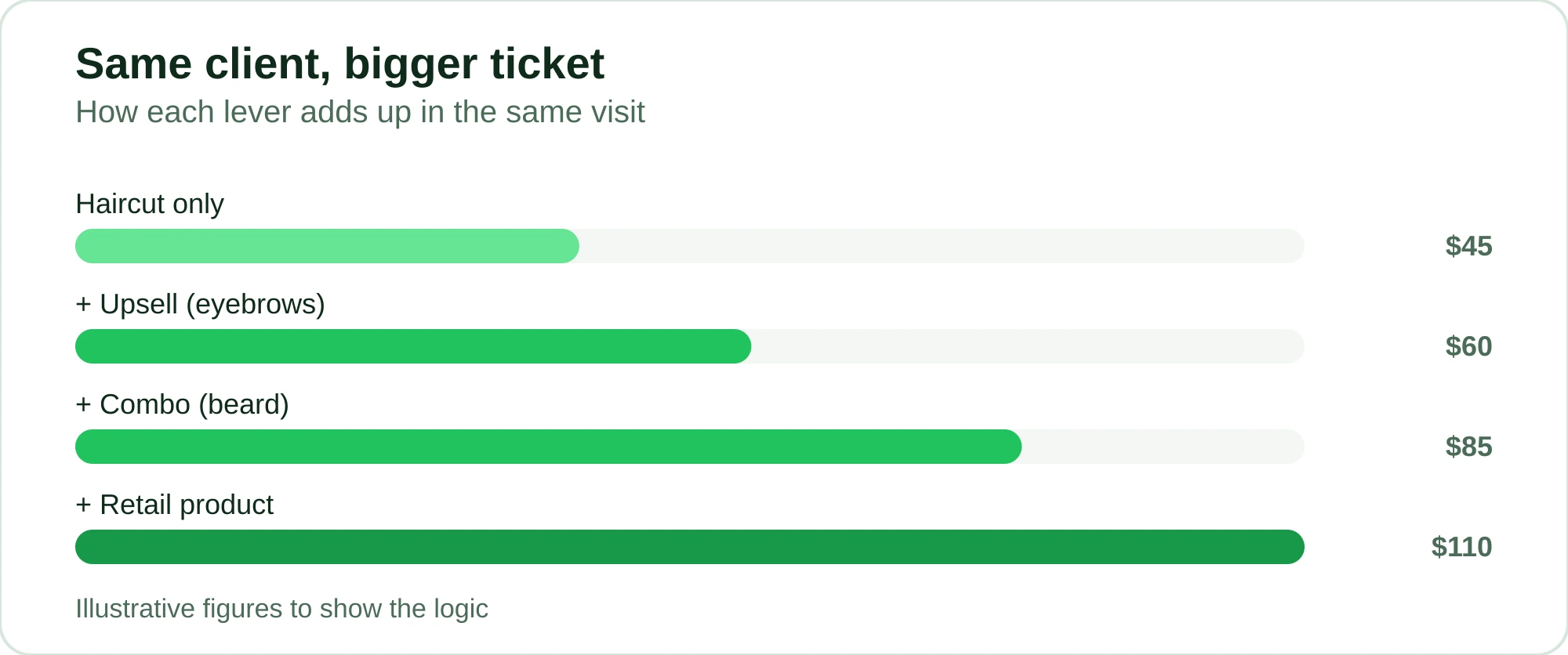
You cut 18 heads on a busy Saturday. Add up the register, divide by 18, and that's your average ticket. Now run a quick example: if each client spent just $10 more, that Saturday would close $180 higher. Over a month, with the same full book, that's roughly $700 to $800 that came in without you serving a single extra person (illustrative figures).
That's the part most barbershop owners miss. The fight isn't only about filling the chair, because the chair is already full. The fight is over what happens during the appointment you already have.
Increasing your barbershop's average ticket means getting the same client, on the same visit, to spend a little more because he left happy and saw the value. No pushing things nobody wants. Below is what actually works at the counter, in the order that makes sense to test.
First, know your number today
Before you try to raise the ticket, you need to know where it stands. Take one month of revenue and divide it by the number of appointments in the same period. That's your average ticket.
Do it per barber too. There's almost always one guy on the team who sells a lot more product and closes combos easily, while another just cuts and sends the client off. Once you see those numbers side by side, it's obvious who needs a nudge and who already has the knack to teach the others.
If your price list is messy or out of date, fix that first. I put together a step-by-step guide in How to Price Barbershop Services and Build Your Price List. A clear price list is the foundation for everything that follows.
Upselling in the chair: the easiest sale there is
The client is already seated, caped, relaxed and trusting you. It's the perfect moment to offer something extra, and the classic mistake is offering nothing at all.
An upsell is simple: suggest something that goes with what he came in for. A few examples that work well:
- Straight-razor eyebrow cleanup while you finish the cut. It takes two minutes, and plenty of clients never asked for it only because nobody offered.
- A conditioning treatment or scalp tonic for someone who complains about dry hair or flaking.
- A zero-guard line-up or neck cleanup for clients who want the cut to last longer between visits.
- A quick facial or face mask, if you offer men's grooming services.
What works: offer one thing, at the right moment, with no pressure. "Want me to tidy up the eyebrows? It cleans up the whole look." If he says no, fine, move on. But in plenty of appointments the answer is yes, and you just added, say, $15 or $20 with no effort.
Train your team to offer, not to push
A barber who feels like a pushy salesman freezes up. Take that weight off. The rule is simple: every finish comes with one suggestion. Not a list of five things, one. The one that makes the most sense for that client.
Once it becomes a habit, nobody has to remember it. And the ticket goes up on its own.
Combos: bundle what the client already wanted
A combo takes two or three services that naturally go together and sells them at one set price, with a small discount that makes "yes" easy.
| Service | Priced separately | As a combo |
|---|---|---|
| Haircut + Beard | $45 + $35 | $70 |
| Haircut + Eyebrows | $45 + $15 | $55 |
| Haircut + Beard + Eyebrows | $45 + $35 + $15 | $85 |
Illustrative figures, just to show the logic. Adjust them to your own prices.
Notice that with the $70 combo the client saves $10, but you got him to add a beard trim he might have left for another time. You trade a small margin for a bigger ticket now, and for a client who gets used to booking the full package every visit.
Make the combos visible: on the mirror, on the service menu, and above all in the booking flow. When the client books and already sees "Haircut + Beard" as an option, he picks it right there, before he even sits down.
Retail at the counter: the forgotten revenue
Pomade, beard oil, shampoo, hair-growth products, trimmers. A client who trusts your cut trusts your product recommendation. And product margins are usually good.
The secret is an honest recommendation tied to the service. "That dryness in your beard, an oil fixes it. I use this one, one drop in the morning." Now you're solving a problem he just told you about, and that carries far more weight than any sales pitch.
A few things that help products move:
- Keep them visible and within reach, near the register and the mirror. Products locked in a cabinet don't sell.
- Use them during the service. If you finished with a pomade and it looks good, the client saw it working. Half the sale is already made.
- Carry a small range, but the right one. Three pomades you trust sell more than twenty nobody knows.
If you want to track that stock and record the sale together with the service without it turning into a mess, RobotiZap has built-in retail sales at the counter. The product goes into the same register as the service, and you can see what sells by professional, including commission on products if you want to encourage the team to sell.
Prepaid packages: money up front and a client who stays (the good way)
A prepaid package means selling, for example, "5 haircuts" at a discount, paid in full today. You get the money in advance and the client has a reason to come back, since he's already paid.
It does three things at once: it raises the value of the initial sale, improves your cash flow and locks in repeat visits. The guy who bought a 5-cut package isn't going to try the shop around the corner halfway through.
It works really well for frequent maintenance services, like clients who get a cut every two weeks or a beard trim every week. I wrote the full walkthrough on how to sell and track them in Prepaid Packages for Salons and Barbershops: How to Sell and Track Them.
In RobotiZap the balance is tracked automatically: the client bought 5 and used 1, the system knows 4 are left and deducts one at each visit. No notebook, no relying on memory.
Bring it all into the booking, not just the counter
There's one detail almost nobody takes advantage of. Everything above (combos, products, packages) usually gets offered only when the client is standing in front of you. But what about the client who books at 11 pm on WhatsApp and disappears until the day of the visit?
When booking is automated, you can offer the combo at the moment of booking. The client who was going to book just "haircut" sees "Haircut + Beard" as an option and chooses the bigger package before setting foot in the shop. The ticket goes up at the source.
The RobotiZap virtual assistant runs on the official WhatsApp API (we're a Meta-certified Tech Provider, so your account stays clear of the ban risk that unofficial tools carry) and answers 24/7. It books on its own, in step-by-step mode or with conversational AI that understands text and even voice messages, and the client doesn't have to download any app. In that flow it shows combos, suggests the full service and can even collect a deposit through an online payment link (card) to lock in the slot.
A deposit collected up front doesn't just raise the amount you receive, it also cuts no-shows. A client who paid in advance shows up. Fewer gaps in the schedule means more chairs filled, and a filled chair is where everything else happens.
Loyalty: make the ticket grow visit after visit
Your average ticket is also built over the year, not in one visit. What matters is how much a client spends with you in total. Someone who comes back more often and books more combos is worth far more than the guy who showed up once.
A points program, winning back clients who disappeared, a birthday message with a small treat, recurring appointments already booked ahead. All of that increases visit frequency, and frequency multiplies the ticket over time. I gathered the tactics that get results in Barbershop Client Retention: 9 Strategies That Work.
RobotiZap runs a points-based loyalty program, sends messages to inactive clients and books recurring return visits automatically, so the work of bringing clients back happens without you having to remember it.
What it costs you
RobotiZap has a single plan, with unlimited bookings and professionals, AI included and no long-term contract. And before you pay anything, you get a free trial.
Look at what it adds. If booking with combos and retail sales add, say, $10 to the ticket across 200 appointments a month, that's $2,000 more (illustrative figures). On top of that come the no-shows the upfront deposit prevents and the hours you stop spending answering WhatsApp by hand.
Plenty of scheduling tools handle the calendar, and they do it well. The difference here is that RobotiZap combines automated WhatsApp service with AI, deposit collection, combos in the booking flow and retail sales in a single plan, with no per-professional charge. For a barbershop that wants to raise what each client brings in, that's what matters most.
Start your free trial and set up your combos and packages today. No commitment.
Frequently asked questions
What's the fastest way to increase the average ticket at a barbershop?
Start with upselling in the chair, because it's the cheapest and easiest sale: the client is already there and trusts you. Train your team to always offer one suggestion at the finish (eyebrows, a conditioning treatment, a line-up) and offer ready-made combos at the moment of booking. Those two moves alone shift the number without needing anything else.
Is selling products at a barbershop really worth it?
It is when the recommendation is honest and tied to the service. A client who trusts your cut tends to trust your pick of pomade or beard oil, and product margins are often better than service margins. Keep a few hand-picked items visible at the counter, and use them during the service so the client sees them working.
How do combos raise the ticket without driving clients away?
A combo bundles services that already go together (haircut and beard, for example) at a set price with a small discount. The client feels he's saving, and you earn more because he adds a service he might have left for another time. The gain comes from volume and frequency, not from squeezing the margin on each item.
Don't prepaid packages lose money because of the discount?
Not if the math is right. You give a small discount, but you get paid up front, improve your cash flow and make sure the client comes back several times instead of trying a competitor. The key is tracking the balance properly: how many visits were used and how many are left. With a system that deducts automatically at each visit, it doesn't become a headache.
Does RobotiZap help increase the ticket or just organize the schedule?
Both. Besides booking on its own over WhatsApp 24/7, it offers combos at the moment of booking, collects deposits through an online payment link (card), tracks prepaid packages, records retail sales at the counter and runs a points-based loyalty program. In other words, it works directly on what makes the ticket go up, not just on keeping the schedule organized. You can try it free.