How to Win Back Inactive Clients on WhatsApp
The client who came in every month and vanished without a word
Winning back inactive clients starts with a scene every barbershop knows: you open today's schedule and there are three empty slots in the afternoon. Then you remember Mark, who got a cut every 20 days, always took the first chair and even brought his son along. He hasn't been in for about four months. No argument, no complaint. He just stopped.
Bringing back a client who drifted away is the cheapest way to fill your schedule. You already paid to win that person over once: they know the place, they liked the cut, they know where you are. Getting them back costs one message. Attracting a new face costs ads, time and hoping they come back a second time.
The problem is that almost nobody does this in an organized way. People remember a missing client by chance, send a one-off message, get no reply and give up. Here you'll see how to turn it into a process that runs on its own.
Who actually counts as an inactive client
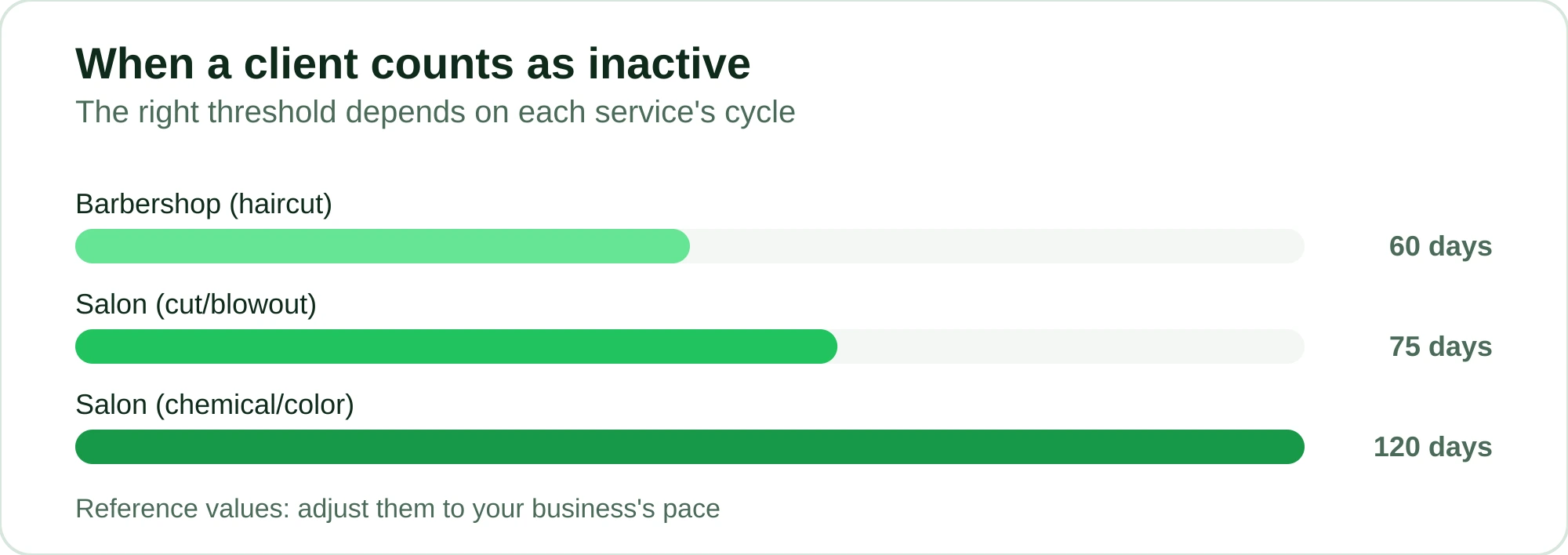
Before you start sending messages, define what "gone" means for your business. It changes with the service.
A man who gets his hair cut usually comes back every 3 or 4 weeks. If more than 60 days go by without a visit, something has changed. A client who gets keratin smoothing or highlights, on the other hand, has a longer cycle: 8 to 12 weeks is normal. Using the same cutoff would have you bothering people who haven't even reached their usual return time.
A simple rule of thumb to start with:
- Barbershop: no visit in more than 60 days = inactive
- Salon (cut/blowout): more than 75 days
- Salon (chemical treatments/color): more than 120 days
Within your inactive clients, split them into two groups, because they deserve different approaches:
- The regular who cooled off: came in all the time, spent well, and stopped. This one is top priority. Even worth a phone call.
- The occasional client: came once or twice and never built a habit. Winning them back is harder, and the effort per person should be lower.
The difference matters because your time is limited. Start with the ones who were worth the most.
Why clients disappear (and none of the reasons is "they hate you")
In the owner's head, the client who disappeared went to a competitor. It's almost never that. The real reasons are much more mundane:
- They forgot. Without a reminder, life gets in the way and the haircut keeps getting pushed back.
- Their routine changed and your hours don't fit anymore, but they never even tried another time.
- They had a so-so experience once (waited too long, got a different professional) and didn't come back, without complaining.
- They moved or changed jobs and the distance became a factor.
Notice that only the last one is hard to fix. The first three are solved with a message at the right time. That's why win-back campaigns work: you just need to remind them you exist and make it easy to come back.
How to win back inactive clients: building the campaign step by step
A win-back campaign isn't sending "long time no see, huh?" to everyone. It's a planned sequence. Here's the step by step.
1. Build the list
Pull the clients who have passed your inactivity threshold. If you keep everything in a paper notebook, you'll have to dig, and you'll probably miss half of them. If you use a booking system, that list already exists, filtered by last visit date. We'll come back to this further down.
2. No need to write a novel, but skip the "Dear valued customer"
A message that opens with "Dear valued customer" dies on the spot. Use their first name and, if you can, mention the service they used to get. "Hi Mark! It's been a while since I took care of your hair" is worth ten times more than a generic blast.
3. Give them a concrete reason to come back now
Missing you doesn't fill a schedule. Offer something with a deadline:
- A slot held for them this week
- A little treat when they return (a free brow cleanup, a complimentary hair treatment)
- A special deal for past clients, valid only until Friday
The deadline helps because without it, people put off the decision and end up not booking.
4. Make replying as easy as possible
What kills a win-back campaign most is friction. If the client has to call, wait for someone to pick up and negotiate a time, they'll drop it. Ideally, they reply to your message and walk away with an appointment booked right there. More on that in the automation section.
5. Don't follow up more than twice
Sent a message and got no reply? One single follow-up a few days later, with a different angle. Still nothing? Let it be. Pushing turns into getting blocked, and being blocked on WhatsApp is worse for you than one less client.
The messages that work
The right message is short, sounds human and ends with a question to open the conversation. Three examples you can adapt:
For the regular who cooled off:
Hi Mark! I noticed it's been a while since you stopped by the shop. Everything OK? I've set aside a slot for you this week if you want to get your hair sorted. Thursday at 6 pm or Saturday morning, which works better?
With a treat on return:
Hi Emily! We've missed you here 😊 To welcome you back, your hair treatment is on me at your next appointment. Want me to book you a day this week?
A light nudge, no offer:
Hey John, how's it going? It's been almost two months since your last cut. Want to book before it turns into a mane? 😄 I've got openings tomorrow and Thursday.
Notice the tone: it sounds like you texting them yourself, the same way you talk to clients at the front desk. If you want a bigger set to test, take a look at Client Win-Back Messages: 10 Templates for Clients Who Disappeared. They're ready-made templates to copy and tweak.
The problem with doing it all by hand
This is where most people get stuck. You may agree with everything above, but you're the owner, the professional, the cashier and the cleaner. Stopping to dig up who disappeared, writing a message to each one, remembering to follow up with whoever didn't answer, booking whoever said yes... it becomes a job that never gets past "I'll do it next week."
And a win-back effort that doesn't happen consistently doesn't work. The payoff comes from running it every month, catching people right as they cross the inactive line, not from a one-time push every now and then.
Automating win-backs with RobotiZap
RobotiZap is a WhatsApp assistant that books appointments on its own, 24 hours a day, and it has a feature built for exactly this: inactive client recovery.
How it works in practice:
- The system identifies who has gone past the threshold you set without booking, so you don't have to hunt for names.
- It sends the win-back message on WhatsApp. Since everything runs on the official WhatsApp API (RobotiZap is a Meta-certified Tech Provider), you send it safely, without the fear of getting banned for using a pirated bulk-messaging app.
- The client replies right there and the virtual assistant books the appointment, either in step-by-step mode (menu) or in AI mode, which understands free text and even voice messages. They don't need to download an app or sign up.
- If you want to make sure that person really shows up, you can ask for an upfront deposit through an online payment link (card) at booking.
In other words, the whole cycle (finding the missing client, reaching out, booking and confirming) happens without you lifting a finger. You wake up and the empty slot has a name on it.
And it doesn't stop at the win-back. Once the client returns, automatic reminders and attendance confirmation lower the chance of a no-show. Add points-based loyalty and prepaid packages, and they have a reason to build the habit again.
What it really costs
RobotiZap has a single plan, with unlimited bookings and professionals, AI included, a free trial and no long-term contract.
Look at it from the front desk: every client a win-back message brings back is a haircut that wouldn't have happened otherwise, on top of the hours you no longer spend hunting for names in a notebook and the no-shows the reminders prevent. It isn't a tech expense; it's an occupied chair.
Winning clients back is part of something bigger
Recovering the clients who drifted away is the tail end of work that starts earlier: if you build loyalty well, fewer people drift away in the first place. It's worth pairing your win-back campaign with an ongoing retention system.
If you run a barbershop, Barbershop Client Retention: 9 Strategies That Work covers what to do so they don't cool off to begin with. If you run a salon, Salon Loyalty Program: How to Build One That Works shows how to keep clients coming back with points and perks.
In the end, the two work together: the better you take care of your existing clients, the fewer disappear and the less you have to chase them later.
Comparing: by hand vs. automated
| Step | By hand | With RobotiZap |
|---|---|---|
| Find who disappeared | Dig through a notebook or spreadsheet | Ready-made list by last visit date |
| Send the message | Type them one by one | Automatic sending on the official API |
| Book the appointment | Call and negotiate | The client books on their own in the chat |
| Follow up with non-responders | You have to remember | Automatic |
| Prevent another no-show | Hope for the best | Reminder + confirmation + deposit |
You can do it all by hand, of course. But by hand, you do it once, get tired and drop it. Automated, it becomes a routine that doesn't depend on your memory on a busy day.
Frequently asked questions
After how long is a client considered inactive?
It depends on the service. In a barbershop, more than 60 days without a visit is already a good warning sign. In a salon doing cuts and blowouts, 75 days. For chemical treatments and color, which have a long cycle, wait about 120 days before reaching out; otherwise you'll bother people who would still come back naturally.
Isn't messaging a client who disappeared annoying?
It is if it's generic and pushy. It isn't if you use their name, mention their service, offer something concrete and stop after one or two tries. With the right name, a concrete offer and no pestering, it comes across as a nice reminder. Generic and repeated, it's spam.
Can I use a bulk-messaging app on WhatsApp for this?
I don't recommend it. Unofficial bulk-messaging apps are the fastest way to get your number banned by Meta, and then you lose the whole channel, not just the campaign. The right way is to use the official WhatsApp API, which is what RobotiZap does as a certified Tech Provider.
Is it worth offering a discount to bring a client back?
It doesn't always have to be a discount. A little treat on return (a free brow cleanup, a hair treatment) usually works just as well and protects your prices. Save big discounts for clients who were very valuable and are hard to bring back. For occasional clients, sometimes a reminder alone does the job.
How do I make win-backs happen every month without depending on me?
Automate them. In RobotiZap you set the inactivity threshold once, and the system starts identifying who crossed it, sends the message and lets the client rebook on their own on WhatsApp. You can start a free trial and see the first missing clients come back before you pay anything.