How to Price Barbershop Services and Build Your Price List
Where to start when you price barbershop services
In most shops, the price list is born like this: you opened the doors, looked at what the place down the street charges and went $5 lower. Done, that's your price. It's also why so many owners work the whole month and end up with nothing left in the account.
A copied price doesn't tell you whether you're making or losing money. To know that, you have to start somewhere else: what it costs you to deliver that haircut. Once you know that, combos, chair time and price increases get easy.
Here's a method you can work through on a sheet of paper tonight.
Step one: find the real cost of each service
Every service has two kinds of cost. The direct cost is what you use up in that appointment (blades, cream, towels, electricity for the clippers, styling products). The indirect cost is what it takes to keep the doors open: rent, power, water, internet, software, accountant, chair maintenance.
The direct supplies for a simple cut are usually low, a few dollars. What really weighs is the shop's fixed costs divided by the number of appointments you can fit in a month.
Do this math:
- Add up all your monthly fixed costs (rent, bills, fixed salaries, software, accountant).
- Estimate how many appointments the shop does in an average month.
- Divide the first by the second. That's the fixed cost built into every appointment.
An illustrative example: fixed costs of $9,000 a month and 600 appointments. That's $15 of fixed cost per appointment. Add direct supplies (say $3) and you have $18 of cost per cut before paying the barber.
That math changes everything. If you charge $30 for a cut, pay 50% commission ($15) and have $18 in costs, your margin is negative. You're paying to work and haven't even noticed.
Step two: set the margin you want
Cost tells you the floor. Margin is how much you want to earn above it.
There's no magic number, but you can think about it this way: after paying for supplies, fixed costs and the barber's commission, how much do you want left over as the shop's profit? Many owners aim for something between 15% and 30% net profit per service. Use that as a reference, not a rule.
The formula for the final price looks like this:
Service cost + barber's commission + profit margin = final price.
Commission belongs in the formula because it's proportional to the price: the more expensive the service, the more the barber takes home. If you're not sure how much commission you're paying per service, stop and work it out before touching the price list. This guide helps: How to Calculate Barber Commission (With Examples).
Step three: price by chair time
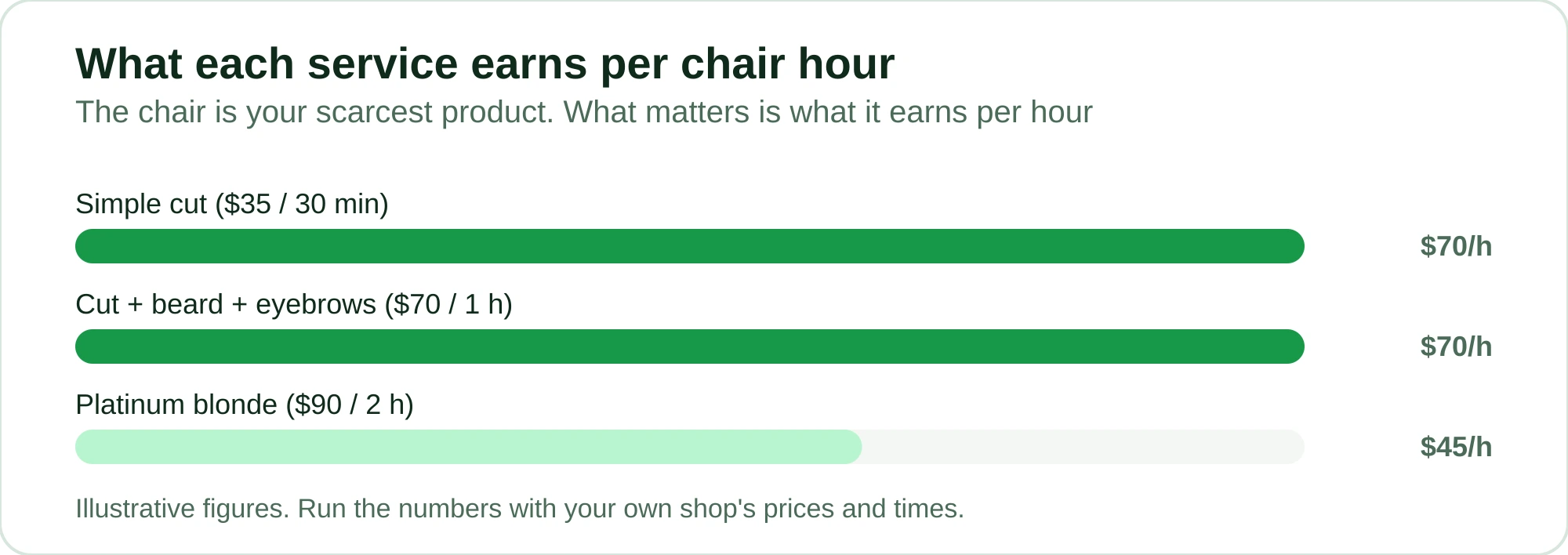
There's one calculation almost no barbershop does: price per hour of chair time. The chair is your scarcest product. Each chair has a limited number of hours a day. So what matters is how much each service earns per hour of chair time, not just what it costs.
Take two services:
- Simple cut: $35, takes 30 minutes. Earns $70 per chair hour.
- Cut + beard + eyebrows: $70, takes 1 hour. Earns $70 per chair hour.
Same earnings per hour, even though the second one costs twice as much. Now take a platinum blonde that takes 2 hours and you charge $90. That earns $45 per chair hour, about a third less than a simple cut. That service may be too cheap for the time it takes.
Work out the hourly earnings for every item on your list. Services that earn little per hour either go up in price, become the exception (booked only at quieter times) or come off the list. It changes which services you prioritize and offer first.
If you want to go beyond pricing and make every chair earn more, there are good ideas here: How to Increase the Average Ticket at Your Barbershop.
Step four: build combos that make sense
A combo isn't just bundling two services and giving a discount. It's there to fill the chair during slow hours and raise the ticket of whoever is already sitting in it.
The logic behind a combo discount is simple: you give up a little margin in exchange for more guaranteed chair time and a bigger ticket. Selling a cut and beard together means that client won't get their beard done at a competitor.
Here's a sample price list (illustrative figures, adjust to your reality):
| Service | On its own | As a combo | Time |
|---|---|---|---|
| Cut | $35 | — | 30 min |
| Beard | $30 | — | 25 min |
| Cut + Beard | $65 | $58 | 50 min |
| Cut + Beard + Eyebrows | $80 | $69 | 1 h |
Notice that the combo discount is small (around 10%), but the ticket goes from $35 to $58 or $69. The client feels they saved money and you bring in more per chair. That's the balance you're after: a discount that fits your margin and still feels like a good deal to the client.
Don't overdo it. A combo with too big a discount trains clients to only come back when there's a promotion and wrecks your margin. The discount exists to reward people who spend more, not to give the service away.
Step five: raise prices without losing clients
A price that never moves loses to inflation. If you haven't raised prices in two years, you've effectively lowered them without noticing, because your costs went up and what you charge stayed the same.
A few practical rules for raising prices calmly:
- Raise prices on a fixed schedule. Once a year is usually healthy. Small, regular increases bother people less than a sudden 30% jump.
- Give notice. Put a sign on the wall and message clients one or two weeks ahead. Clients don't fight price increases. They fight surprises at the register.
- Start with what has a waitlist. If Friday and Saturday slots are always full, that's the market telling you your price is low. Raise those first.
- Pair the increase with an improvement. New towels, better coffee, a new chair? That's the moment. Clients link the new price to something better.
One thing that keeps clients through a price increase: predictability. People who know they can book easily, get a reminder and never wait for a reply on WhatsApp complain a lot less about paying $5 more. The experience around the haircut is part of what you're charging for.
Where booking fits into the pricing math
There's a hidden cost that destroys margin and never appears on your price list: the no-show. You reserved the chair, blocked the time, turned another client away, and the guy didn't show up. That chair hour was worth zero. If it happens a few times a week, that's real money leaving every month.
This is where RobotiZap helps protect the price you just built. It's an assistant that answers on WhatsApp and books appointments on its own, 24 hours a day, with no app to download and no sign-up for the client. The client sends a message (or a voice note) and the virtual assistant books the slot, either through a step-by-step menu or by chatting with AI.
In practice, it hits your margin directly in three ways:
- Automatic reminders and attendance confirmation, which reduce no-shows. When the chair sits empty, you earn nothing for that hour.
- Upfront deposits through an online payment link (card), for long services like a platinum blonde, where a no-show really hurts.
- Hours saved in your day answering "any openings tomorrow?" on WhatsApp, time you give back to the chair.
RobotiZap has a single plan, with unlimited bookings and professionals and AI included, and you can start with a free trial. Think about what each empty chair you avoid is worth: it's exactly the chair hour your price list was built on.
If you run the shop with several barbers, each with their own schedule and a different commission, you can see how it all fits together in our guide Best Barbershop Booking Software: How to Choose.
Frequently asked questions
How do I calculate the price of a men's haircut?
Add the direct cost of the service (supplies) to the share of the shop's fixed costs that falls on that appointment, then add the barber's commission and the profit margin you want. The result is the minimum healthy price. Then compare it with the chair time the cut takes to see whether it earns well per hour.
What's the ideal profit margin for a barbershop?
There's no single number, because it depends on your fixed costs, your location and your volume of appointments. Many owners aim for something between 15% and 30% net profit per service, but treat that as an illustrative reference. What matters is setting prices from your real costs, not copying another shop's number.
Is it worth discounting a haircut and beard combo?
Yes, as long as the discount is small and fits your margin. The gain from a combo is raising the ticket of someone already in the chair and making sure the client gets both services from you, not a competitor. Too big a discount turns into a loss and trains clients to only come back during promotions.
How often should I update my price list?
Once a year is a healthy interval for most shops. Small, predictable increases bother people less than a big jump after years without changes. Give clients one or two weeks' notice and, if you can, pair the increase with a visible improvement in the service.
Do no-shows belong in the pricing calculation?
Not directly, but no-shows destroy the margin you calculated, because they turn a chair hour into zero revenue. That's why it pays to reduce them with reminders, confirmations and, for long services, deposits. The fewer empty chairs, the better the price you built holds up. You can try RobotiZap free and see the effect on your schedule.