How to Calculate Barber Commission (With Examples)
How to calculate barber commission without losing your Sunday night
Friday, 7 pm, the shop is packed. Then on Sunday you sit down to close the month and find out that working out barber commission by hand is a puzzle: one barber did plain cuts, another did cut and beard, one sold three jars of pomade, and there was the day he covered for a colleague who didn't show up. Every case pays differently, and in the rush you jot it all down in a notebook nobody can read later.
There aren't many commission methods that work in a real barbershop. I'll go through each one with the math done, the mistakes that cause the most arguments at month-end, and how to make the whole thing run on its own.
The commission models you can use
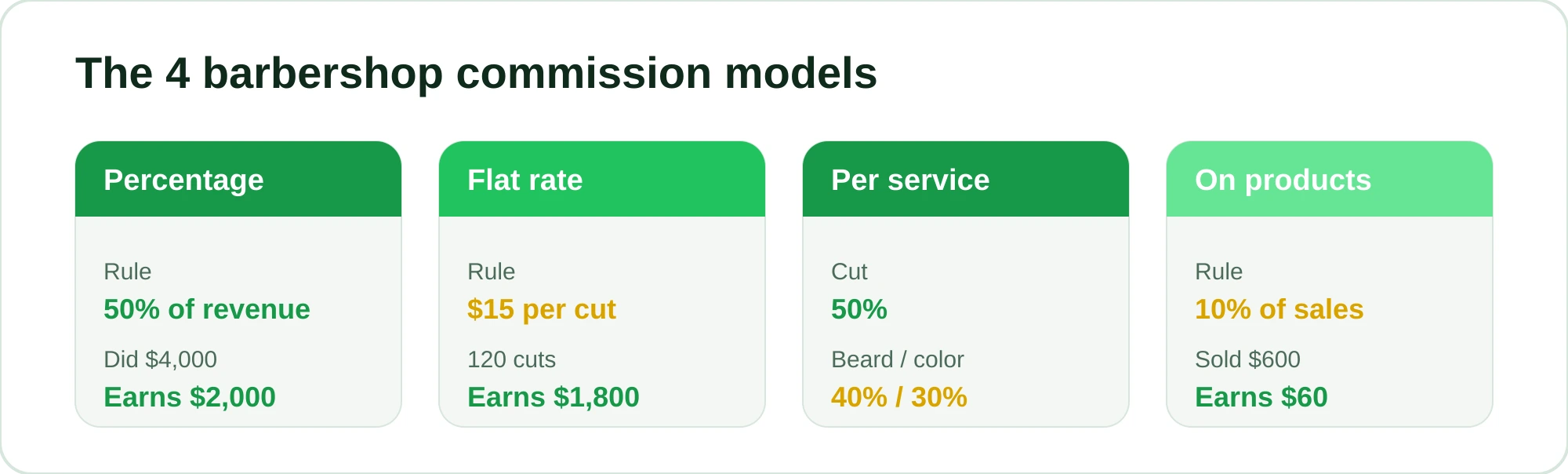
There's no single "right" model. There's the one that fits your kind of shop and the deal you made with each professional. The four most common are:
1. Percentage commission
The barber gets a share of everything he brings in. This is the most common setup.
Example: a 50% commission and the barber did $4,000 in services in the month. His commission is $2,000 (illustrative figures).
The percentage varies a lot from city to city and from deal to deal. In many places it lands somewhere between 40% and 60%, but that depends on who pays for product, who brings in the client and how the chair is set up. Some shops don't pay commission at all and rent the chair to the barber for a fixed fee instead. There's no magic number.
2. Flat rate per appointment
Instead of a percentage, you pay an agreed amount per service, no matter what the client paid.
Example: $15 per cut. The barber did 120 cuts in the month and earns $1,800. It's easy to understand, but it stops making sense when your services have very different prices (a $30 cut and an $80 combo paying the same commission rarely goes down well).
3. Commission per service
Here each service has its own rule. Cuts pay 50%, beards pay 40%, color pays 30% because the product is expensive. This model is fairer when each service costs you something different.
4. Commission on product sales
Pomade, minoxidil, shampoo, beard kits. It makes sense to reward counter sales with a separate commission, usually lower than the service one, because product margins are already tighter.
Example: 10% on products. The barber sold $600 in pomade and earns $60.
In practice, most barbershops mix them: a percentage on services, a smaller percentage on products, and sometimes a flat rate for one specific service.
Worked example: one barber's month
Let's build a full month for a barber named Leo, on a mixed model. The deal:
- 50% on services
- 10% on products sold
In the month, Leo did (illustrative figures):
| Item | Revenue | Commission | Amount due |
|---|---|---|---|
| Cuts (80 × $40) | $3,200 | 50% | $1,600 |
| Beards (45 × $30) | $1,350 | 50% | $675 |
| Pomade and products | $500 | 10% | $50 |
| Total | $5,050 | — | $2,325 |
Leo takes home $2,325. Clean math, and everyone can see where every cent came from.
Now see what changes if you take a deposit up front. Say two of Leo's clients paid a $20 deposit through an online payment link (card) to hold their slot. That money came in earlier and is taken off the service total. The commission is still calculated on the full service price, not on what was left to pay. That's exactly the kind of detail that causes confusion when you track everything on paper.
The mistakes that show up at month-end
Mixing commission with tips
Tips belong to the barber, period. They don't go into the commission calculation and they aren't the shop's revenue. When they get mixed up in the till, nobody knows what's what anymore.
Forgetting what the shop pays for
If the shop covers the supplies used in the service (blades, cream, disposables), that needs to be clear in the deal. Paying 50% on a service where the shop still absorbs expensive supplies can eat into your margin without you noticing.
Not separating services from products
Paying the same percentage on a cut and on a jar of pomade undercuts your own margin. Products have a purchase cost. Give each one its own rule.
Calculating from memory
"I think Leo did about 70 cuts." Guesswork at month-end is a guaranteed argument. If you don't have an exact record of every appointment per professional, any commission calculation is a shot in the dark. This is where organizing your barbershop schedule stops being a nice-to-have and turns into money. Without a record of every appointment, no commission calculation adds up.
Putting off the month-end close
The longer you push it back, the more forgotten appointments and lost tickets you get. Ideally the number is always up to date, instead of you rebuilding the whole month on a Sunday night.
How to decide the right percentage
A commission percentage doesn't come out of thin air. Before you close a deal with a barber, think about:
- Who brings in the client. If the traffic comes from your brand, your location and your marketing, the shop keeps a bigger share. If the barber arrives with his own client list, he usually negotiates more.
- Who pays for product. A shop that covers everything works with a lower percentage for the barber. A barber who buys his own supplies negotiates a bigger share.
- The fixed cost of the chair. Rent, utilities, software, front desk. All of that comes out of the shop's side.
- The type of service. A tight-margin service (with expensive product) calls for a lower commission.
There's no point copying the percentage from the barbershop down the street. The deal that works for them can sink you if your cost structure is different. If you're still setting your prices, it's worth lining this up with your barbershop price list before you define the commission.
How to automate the commission calculation
Calculating barber commission by hand works while you have one barber. With two, three or four professionals, each on a different deal, the notebook can't keep up. And running several professionals on one schedule without a system is where most owners lose time and money. If you're still choosing a tool, it's worth reading how to choose the best barbershop booking software before you decide.
The way out is to let the record happen on its own, at the moment of the appointment, and have the math come out ready at month-end.
That's what RobotiZap is for. It's a WhatsApp assistant that books appointments on its own, 24 hours a day, and every booking is logged under the right professional. When it's time to close the month, the commission is already calculated the way you set it up:
- Global commission (one percentage for everyone),
- per service (cut 50%, beard 40%, and so on),
- per product (a separate share for counter sales).
Because RobotiZap gives each barber an independent schedule and a professional portal, each one sees their own appointments and you see the shop's total. Counter product sales go into the calculation too. At month-end, there's no notebook to rebuild: the number is already there.
And there's an effect nobody thinks about at first, but it adds up: clients who don't miss appointments. RobotiZap sends automatic reminders and asks for attendance confirmation, and you can also take a deposit through an online payment link (card) at the time of booking. Fewer gaps in the schedule mean more chairs filled, and a filled chair means a bigger commission for the barber and more revenue for the shop. RobotiZap's AI handles text and voice notes on the official WhatsApp API (the company is a Meta-certified Tech Provider), and the client doesn't need to download any app.
RobotiZap has a single plan with unlimited bookings and professionals, and it gives you back the hours you used to spend working out commission by hand, on top of the no-shows it helps prevent. You can start with a free trial.
Start your RobotiZap free trial and get your commission calculation ready at month-end.
Frequently asked questions
What's the ideal commission percentage for a barber?
There's no single number. It depends on who brings in the client, who pays for product and what your chair's fixed cost is. In many cases the service commission falls somewhere in the middle range, but what matters is a deal where the shop covers its costs and the barber feels well paid. Work it out from your own structure, not from the shop next door.
Is barber commission calculated with or without the product?
Keep the two apart. On the service you apply the service commission; on the product sold, a product commission (usually lower, because the margin is tighter). Lumping everything into one percentage tends to eat your margin on product sales.
How do I calculate commission if the barber sells products?
Set a specific percentage for products and apply it to the amount sold. Example: 10% on $500 in pomade comes to $50. Add that to the service commission to get the barber's total. In a system like RobotiZap, those counter sales go into the month-end close automatically.
Do tips count toward commission?
No. Tips belong to the barber and aren't the shop's revenue, so they stay out of the commission calculation. Keeping them separate in the till avoids confusion when you close the month.
Do I need a system to calculate commission?
With one barber, paper works. From two or three on, each with a different deal, doing it by hand becomes a source of errors and arguments. A system that logs every appointment under the right professional and applies the commission rules automatically saves hours and takes the guesswork out of month-end.