Salon Waitlist: Fill Empty Slots Automatically
Why a salon or barbershop waitlist is worth as much as a new client
Friday, 5:40 pm. Bruna's chair was about to sit empty from 6:00 to 7:30 because the client who had booked a cut and highlights texted, "Something came up, can we reschedule?" An hour and a half of your book on the best day of the week, down the drain. And you know there are clients who WOULD grab that slot right now. But you don't have their number at hand, you can't remember who said "let me know if anything opens up," and you're not going to start texting 30 people hoping someone replies.
That's exactly the gap a waitlist fills. And when it's automatic, it fills the gap on its own while you take care of the next person in the chair.
A salon or barbershop waitlist is an organized queue of clients who wanted a time slot that was already full. When a cancellation opens it up, the system notifies those people right away. Whoever confirms first gets the slot. That's the difference between losing $100 from your book and filling the slot before you've even finished the appointment you're on (illustrative figures).
The real cost of an empty slot (and why it hurts more than it seems)
A cancellation costs more than the lost appointment. It adds up:
- The revenue from that slot disappears. A $40 men's cut, a $60 blowout, a $70 hair and beard combo (illustrative figures). Multiply that by how many last-minute cancellations you get each week.
- The professional sits idle, but the costs keep running. You don't pay commission on an empty chair, but you do pay rent, power and that person's time.
- A slot canceled at the last minute is almost never refilled when you do it by hand. You're with a client, so you can't stop to make calls.
In many salons, a good share of slots canceled less than 24 hours ahead simply never get refilled. Not because there's no one who wants them: what's missing is a fast way to tell the people who do. The client exists. They just never find out the slot opened up.
If no-shows and cancellations are a recurring headache for your business, read the complete guide to reducing no-shows at your salon or barbershop. The waitlist is one piece of that puzzle, but not the only one.
How the waitlist works in practice
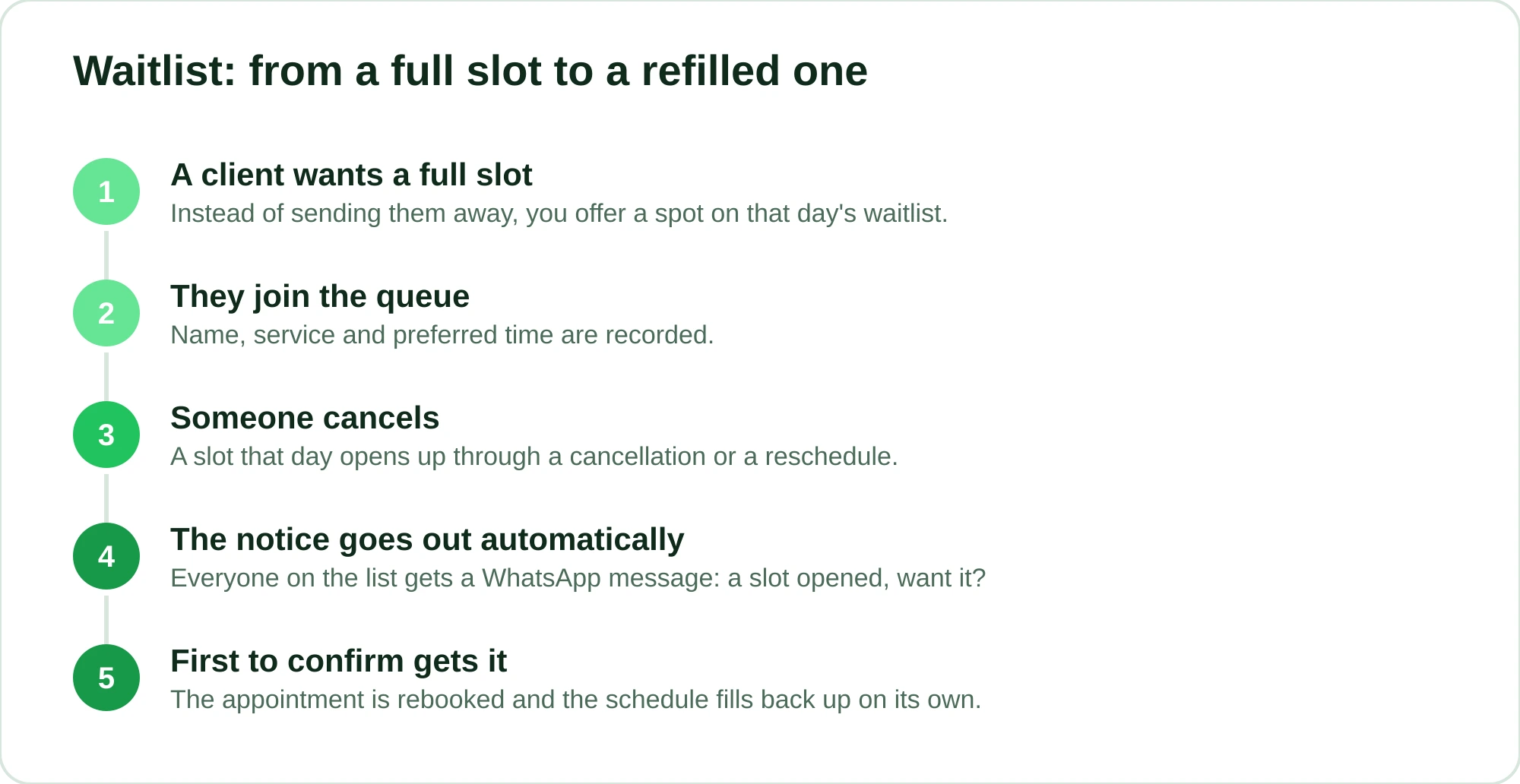
In practice, it works like this:
- A client wants a slot that's full. Carla wanted Saturday at 10 am, but it was already taken. Instead of sending her away, you (or the virtual receptionist) offer to put her on the waitlist for that day.
- She joins the queue. Her name, service and preferred time are recorded.
- Someone cancels. The Saturday 10 am slot opened up because the original client canceled.
- The notification goes out automatically. Everyone on that day's waitlist gets the message: "A slot just opened on Saturday at 10 am for [service]. Want it? Reply YES."
- Whoever confirms first gets the slot. The appointment is rebooked, the schedule is full again, and nobody on the team had to stop cutting hair to sort it out.
The sticking point when you do this by hand is step 4: the notification only goes out if you remember, have the time and have the contact at hand. When something takes care of that for you, a slot canceled at 5:40 pm can be filled again by 5:50 pm.
Why this isn't the same as messaging everyone
Be careful not to mix the two up. Blasting a message to every client of the salon saying "slot open on Saturday" is a shot in the dark: it bothers people who aren't interested, and the notice gets lost among promotions. The waitlist goes straight to the people who asked for that day or that service, without pestering anyone who isn't interested. It's a "yes" the person already gave. That's why the response rate tends to be much better.
Where the waitlist fits in your anti-no-show strategy
The waitlist handles the "a slot opened, I need to fill it" side. But it works best alongside two other fronts:
- Reducing cancellations before they happen. This is where automatic WhatsApp appointment reminders come in. A client who gets reminded is a client who shows up, or who at least lets you know in advance that they can't make it. And the sooner you know about the opening, the more time the waitlist has to work.
- Making the rules clear. A well-defined cancellation policy gets clients to cancel ahead of time instead of vanishing at the last minute. A slot freed up 12 hours in advance is much easier to refill from the waitlist than one that opens with 10 minutes to go.
To sum up the trio: reminders cut no-shows, the policy organizes cancellations, and the waitlist reuses whatever slot is left over. Each one covers a different piece.
What this can add up to at the end of the month
Let's run an illustrative calculation with numbers you can adjust to your reality. Picture a barbershop with an average ticket of $50 and three last-minute cancellations a week that would normally sit empty:
| Scenario | Slots refilled/week | Revenue recovered/month* |
|---|---|---|
| No waitlist | 0 to 1 | up to $200 |
| Automatic waitlist | 2 to 3 | $400 to $600 |
*Illustrative estimate: 4 weeks, $50 ticket. Adjust for your own ticket and volume.
Even at the low end, refilling two slots a week adds up over the month. And it's revenue from clients you had already written off, recovered without anyone having to stop and make calls.
How RobotiZap makes the waitlist run on its own
RobotiZap is a WhatsApp virtual receptionist that takes care of your salon's or barbershop's schedule 24 hours a day. When the time a client wanted is full, instead of losing the sale, the assistant offers to put them on the waitlist for that day. It all happens inside WhatsApp, without the client downloading any app or filling out a sign-up form.
When someone cancels, RobotiZap detects the open slot and notifies the people in the queue: automatically, right away, without you having to stop what you're doing. Whoever replies first gets the slot, and the schedule rearranges itself.
That notification can go out in two ways, depending on how you prefer to work:
- Step-by-step mode: the client receives the message with the open slot and confirms through a quick menu.
- AI mode: the assistant understands free text and even voice notes. The client can reply "sure, book it, but I can only get there at 10:15" and the AI fits them in.
Because RobotiZap runs on the official WhatsApp API (RobotiZap is a Meta-certified Tech Provider), these notifications go out through an approved channel, which protects your business number from the ban risk that unofficial tools face.
And the waitlist is only one part. In the same place you also manage the schedules of several professionals at once, charge an upfront deposit through an online payment link (card) to lock in the slot, send automatic reminders and ask for a review after the appointment. RobotiZap has a single plan, with unlimited bookings and professionals.
Every slot the waitlist refills is revenue you had already written off, and that's before counting the time you save by no longer being tied to a notebook.
Start your free RobotiZap trial. Turn on the waitlist and see how many slots you can save in the very first week.
Frequently asked questions
What is a salon or barbershop waitlist?
It's an organized queue of clients who wanted a time slot that was full. When a slot opens up, through a cancellation or a reschedule, those clients are notified and whoever confirms first gets it. With RobotiZap, that notification goes out automatically on WhatsApp, so the slot gets filled without you having to call anyone.
Does the waitlist work without the client downloading an app?
Yes. Everything happens inside the WhatsApp the client already uses. They join the list, get notified about the opening and confirm by message, without installing anything or filling out a sign-up form.
What's the difference between a waitlist and a mass message?
A mass message sends the same text to everyone, bothers people who aren't interested and gets lost among promotions. A waitlist only notifies people who asked for that day or service. Since they've already shown interest, the chance they'll reply and take the slot is much higher.
Does a waitlist prevent losses from last-minute cancellations?
It tackles the refilling side: it turns a slot that would have sat empty into recovered revenue. To reduce cancellations themselves, pair the waitlist with automatic reminders and a clear cancellation policy. Together, the three cover both prevention and recovery.
Do I need to keep an eye on WhatsApp to notify the waitlist?
No. That's the whole point. RobotiZap detects the open slot and sends the notification on its own, 24 hours a day, while you work. You just see the slot fill up again in your schedule.