Salon Cancellation Policy Template (for Barbershops Too)
Why having a cancellation policy template changes your day
Friday, 5 pm. Three chairs full, and the 6 pm client vanishes without a word. They don't answer, nobody takes their place, and that gap becomes a loss at the most valuable hour of the week. A well-written cancellation policy template won't stop no-shows on its own, but it sets the rule ahead of time, so you're not left begging clients to show up.
A cancellation policy is just that: agreeing in advance on what happens when someone cancels or disappears. How much notice they need to give. What happens if they don't. Whether there's a deposit and when it's refunded. A business without this rule in writing ends up deciding on impulse, client by client, and that leads to arguments and unfairness.
Here you'll get a ready-made template to adjust and post in your booking page, on Instagram and on WhatsApp. And, more importantly, you'll see how to communicate it without sounding harsh.
What every cancellation policy needs
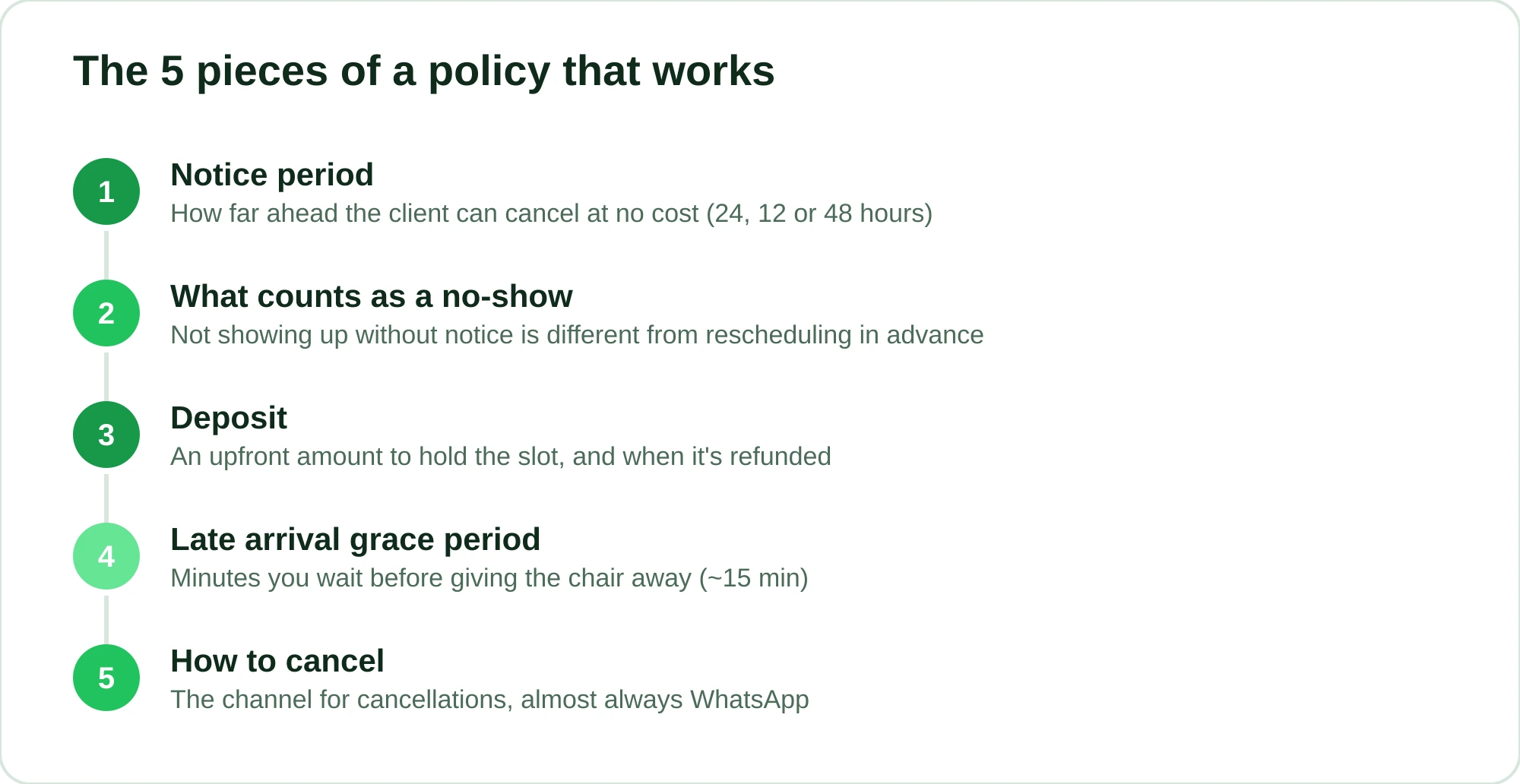
Before copying any text, understand the pieces. A policy that works at the front desk has five parts:
- Notice period. How far ahead the client needs to let you know to cancel or reschedule at no cost. 24 hours is common, but you can use 12 or 48 hours depending on how busy you are.
- What counts as a no-show. Not showing up and not letting you know is different from rescheduling in advance. Make that clear.
- Deposit. Whether you charge an amount upfront to hold the slot, and when it's refunded or forfeited.
- Late arrival grace period. How many minutes you wait before giving the chair to someone else. Fifteen minutes is reasonable.
- How to cancel. The channel the client uses to cancel. In your case, almost always WhatsApp.
None of this needs to be strict; it needs to be clear so clients know what to expect. A client who knows the rule beforehand doesn't feel betrayed when it's applied.
Cancellation policy template (copy and adjust)
Below are three versions. Pick the one that suits your business and replace the values in brackets with your own. Before you publish it, check your local consumer rules on deposits, refunds and cancellation fees, since they vary by country and region.
Short version (for your Instagram bio and the top of your booking page)
To cancel or reschedule, please give at least [24 hours] notice. Late arrival grace period: [15 minutes]. No-shows without notice may require a deposit for the next booking.
Full version (to send on WhatsApp and post at your shop)
Booking policy — [Salon/barbershop name]
- Rescheduling and cancellations: let us know at least [24 hours] in advance on our WhatsApp. Within that window, you can reschedule at no cost.
- Late arrivals: we hold your chair for [15 minutes]. After that, we may need to fit you in at another time, depending on the schedule.
- No-shows: when a client doesn't show up and doesn't let us know, the slot is lost. After [1 no-show], your next booking may require an upfront deposit of [$XX] or [X%] of the service.
- Deposit: when there is one, it comes off the total on the day. Canceled within the notice period? The deposit is refunded. No-show without notice? The deposit covers the reserved slot.
These rules keep the schedule fair for everyone. Thanks for understanding.
Mandatory deposit version (for peak times or long services)
For services of [length/price] or more and for Saturday appointments, we ask for a [$XX] deposit to confirm. It comes off the total on the day. Canceling more than [24 hours] ahead: deposit refunded. Less than [24 hours] or a no-show: deposit kept.
You don't need to require a deposit from every client. Many owners use it only for new clients or for the longest services, where an empty chair hurts the most.
How to set the right notice period for your business
The notice period depends on how quickly you can fill an empty slot.
| Situation | Suggested notice | Why |
|---|---|---|
| Full schedule, active waitlist | 24 to 48 hours | You have time to bring in another client |
| Average traffic, easy to fill | 12 to 24 hours | A balance between firmness and flexibility |
| Long service (color, highlights, makeovers) | 48 hours + deposit | The chair is tied up for hours; the risk is higher |
| Peak time (Saturday, the day before a holiday) | 24 hours + deposit | High demand, every slot is worth more |
If you usually manage to fill last-minute gaps, you can be more flexible. If a 4 pm cancellation means an empty chair until closing, tighten the notice period and consider a deposit. For the full picture on no-shows, there's a guide to reducing no-shows at your salon or barbershop.
Deposits: when to use them without scaring clients off
Deposits are the topic that holds salon owners back the most. The fear is real: "What if the client gets annoyed and leaves?" It happens less than you'd think. The client who complains about paying $15 to hold a slot tends to be the same one who doesn't show up (illustrative figure). The deposit can be a small part of the service, just enough for the client to commit.
A few ways to start charging without scaring clients:
- Start with the extreme cases. Apply a deposit first on Saturdays and for long services. Clients get it.
- Always take it off the bill on the day. Make it clear the deposit goes toward the price of the service. It doesn't disappear; it becomes a payment. That changes how clients see it.
- Refund it when the client lets you know. The rule has to be fair both ways. Anyone who cancels within the notice period gets it back.
- Use an online payment link (card). The client pays in a few taps, right from the WhatsApp chat on their phone.
There's a step-by-step guide to the messages and approach in how to charge appointment deposits without losing clients, including the exact text to send when you confirm a booking.
How to communicate your policy without sounding harsh
The rule can be firm without you having to be curt about it. The difference between "drove the client away" and "the client respected it" is almost entirely in the wording.
Avoid:
"We don't tolerate no-shows. Anyone who doesn't give notice will be fined and blocked."
Try instead:
"So we can take good care of everyone, we ask for 24 hours' notice if you need to cancel. That way we can offer the slot to someone else. Sound good?"
Three principles help:
- Explain the why. "To keep the schedule fair for everyone" works better than a threat. People accept rules when they understand the reason.
- Show it at confirmation, not just when charging. The best time to mention the policy is when the client has just booked and is happy, not after they've missed an appointment.
- Be consistent. Applying the rule to one client and letting another off the hook destroys trust in the rule. When it applies to everyone, nobody takes it personally.
Where your policy should appear
A nice template stuck in a notebook doesn't help anyone. Clients need to run into it in at least three places:
- In the booking confirmation, in one short line.
- In the reminder sent the day before, next to the attendance confirmation button.
- In a fixed spot (your Instagram bio, your WhatsApp automatic message, a small sign at the front desk).
This is where automating your customer service works in your favor. When a client books on WhatsApp, the rule shows up in the same conversation, without you having to remember to type it.
How RobotiZap applies your policy on its own
Writing the policy is the easy part. The real work is applying it every time, without relying on someone at the front desk to remember. That's what RobotiZap does on WhatsApp.
RobotiZap is an assistant that books appointments on its own, 24 hours a day, right in WhatsApp, without the client downloading an app or signing up. It works in step-by-step mode (menu) or with AI that understands free text and even voice notes. In practice, for your cancellation policy, that means:
- The rule appears in the confirmation automatically, the moment the client books.
- Automatic reminders with attendance confirmation the day before, which is where most no-shows are prevented.
- Deposit collection through an online payment link (card) at booking time, with the amount taken off the bill on the day. You decide which services or times require it.
- A waitlist that offers the open slot to another client when someone cancels, so the chair doesn't sit empty. See how the waitlist fills slots on its own.
And because RobotiZap runs on the official WhatsApp API (the company is a Meta-certified Tech Provider), you don't run the risk of having your barbershop's number blocked for using an unofficial tool.
Every peak-time slot that no longer sits empty is revenue you keep. RobotiZap has a single plan, with unlimited bookings and professionals, deposits and AI included, with no add-ons. And you can start with a free trial and no long-term contract.
Start your free RobotiZap trial and let your cancellation policy work on its own.
Frequently asked questions
What's the ideal cancellation notice period for a salon or barbershop?
Twenty-four hours works for most. If you can fill empty slots quickly, 12 hours may be enough. For long services or Saturdays, 48 hours with a deposit better protects the most valuable chair time of the week.
Can I charge a fee for cancellations or no-shows?
The simplest and least awkward route is an upfront deposit that comes off the bill on the day, instead of a fee charged afterward. The deposit already covers the reserved slot when the client doesn't show, and it avoids that uncomfortable after-the-fact charge. Whichever you choose, check your local consumer rules first, since what you can charge and refund varies from place to place.
How do I tell clients about the policy without sounding rude?
Explain the reason ("to keep the schedule fair for everyone"), show the rule at confirmation and not just when charging, and apply it equally to everyone. A firm policy in friendly language solves almost everything.
Should I charge a deposit from every client?
You don't have to. Many owners start by requiring a deposit only from new clients, at peak times or for long services, where the risk is higher. As you gain confidence in the rule, you can decide whether to expand it.
Where should I make my cancellation policy visible?
In at least three places: in the booking confirmation message, in the reminder the day before and in a fixed spot like your Instagram bio or a small sign at the front desk. The more naturally the rule shows up, the less it feels like a threat.