
How to Charge Appointment Deposits Without Losing Clients
Why a fully booked Friday turns into a loss (and how charging a deposit fixes it)
It's the Friday before a long weekend and your schedule is full from 9 am to 8 pm. Then three clients don't show up, two cancel at the last minute and one simply vanishes. You're left with four gaps on what should have been the best day of the week, and you turned away people who wanted those slots. Anyone who works by appointment knows this pain well.
The most direct fix is to ask for a deposit at booking. A client who pays, say, $10 or $20 to hold the slot thinks twice before skipping it. The problem is that many owners freeze when it's time to ask, afraid of sounding rude and scaring clients away. You can charge without that happening. I'll show you how in practice, from the percentage to the exact wording of the message.
One thing before the "how": the rules around deposits vary from place to place, so check your local consumer rules before you start. Here, the focus is on setting up the charge without losing clients along the way.
Why charging a deposit works against no-shows
A no-show isn't just an empty slot. It's product you bought and didn't use, a professional standing around on the clock, a client on the waitlist who didn't get in. Every idle chair during peak hours is expensive.
A deposit changes the client's mindset because it creates a financial commitment. Booking and not showing up stops being "free." When there's money involved, people let you know in advance if they can't make it, and then you can fill the slot. It isn't magic and it won't bring no-shows to zero, but in many cases it sharply cuts the number of people who disappear without a word.
There's a detail few people notice: a deposit also separates serious clients from the merely curious. The person who books at three places "to see which one works out" rarely pays a deposit at all of them. You're left with the people who actually want to come.
If no-shows are a big problem in your business, the deposit is one piece of a bigger picture. Take a look at How to Reduce No-Shows at Your Salon or Barbershop: The Complete Guide to build the whole strategy, with reminders and confirmations alongside.
How much to charge: the right deposit percentage
There's no magic number, but there is a range that tends to work without scaring people off. The idea is to make it high enough to sting if the client skips, and low enough that it doesn't become a barrier at booking.
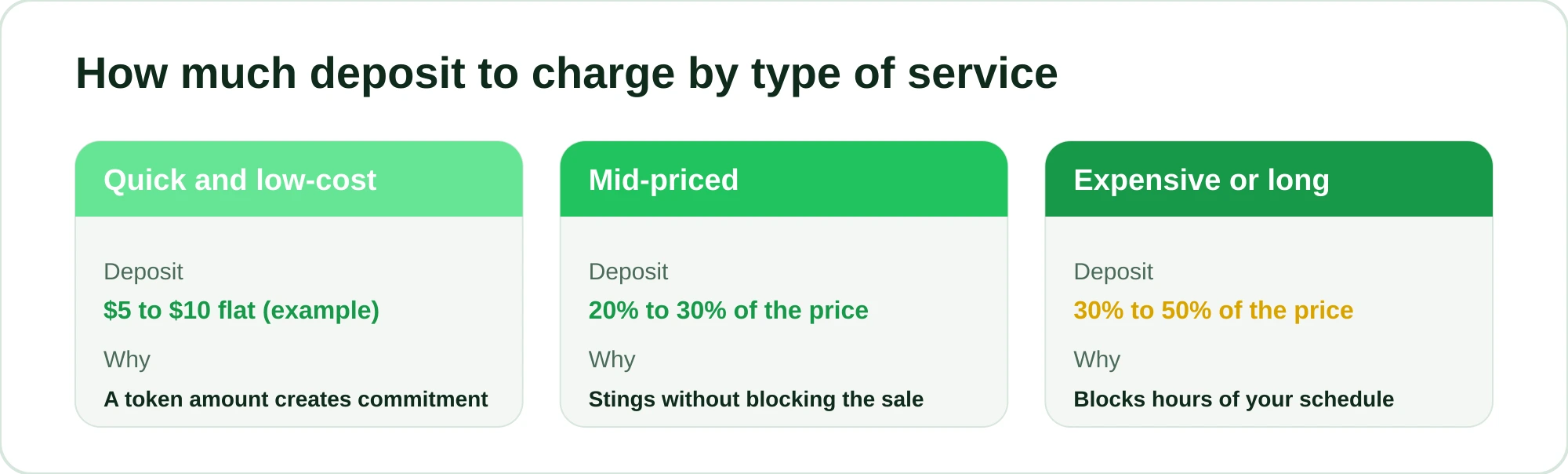
In practice, most service businesses work within a range like this:
| Type of service | Suggested deposit range | Why |
|---|---|---|
| Quick, low-cost cut or service | Low flat amount (for example, $5 to $10) | A percentage would be negligible; a small flat amount already creates commitment |
| Mid-priced service | 20% to 30% of the price | Stings enough to prevent the no-show without blocking the sale |
| Expensive or long service (chemical treatments, keratin smoothing, bridal packages) | 30% to 50% | It blocks hours of your schedule; the risk of a no-show is higher, so the deposit follows |
| New client, first visit | Raise the percentage | New clients miss the most; regulars have already proven they show up |
The percentages above are illustrative. The right number is whatever fits your business and your clientele. A more price-sensitive neighborhood calls for a smaller deposit; a premium service can easily carry a bigger one.
A rule that helps: treat the deposit as an advance that comes off the final price. The client pays, for example, $20 now and settles the rest on the day. Making this clear removes almost all resistance, because people understand they aren't paying "extra," just paying part of it up front.
How to ask without sounding rude
This is where most people go wrong. It isn't the deposit that scares clients off, it's the way you ask. A suspicious tone, a curt message, looking like you treat everyone as a potential deadbeat: that's what drives people away.
A few things that work:
- Present it as house policy, not an exception. "To confirm your appointment, we ask for a $X deposit" sounds much better than "I need you to pay up front or I can't guarantee the slot." The first is a policy; the second is a demand.
- Explain why, honestly. People understand when you say "it's so the slot is reserved just for you." Nobody likes to arrive and find their professional busy because someone else "got squeezed in."
- Make it clear it comes off the price. I'm repeating it because it's the point that unlocks the most: this amount is already part of the service price, so nobody pays anything extra.
- Be specific about the amount and how to pay. "$15 by card, I'm sending you the payment link now" gets things done faster than a vague message.
- Have a clear rescheduling rule. Gave notice X hours in advance? The deposit carries over to the next appointment. That takes away the fear of "losing the money" and shows you're fair.
If you want ready-made text to adapt to your business, we've put together plenty in 12 Deposit Request Message Templates for Appointments. Grab one, adjust the amount and your shop's tone, and use it.
An example of what to say
"Perfect! I can fit you in Thursday at 3 pm with John. To keep the slot reserved just for you, we ask for a $15 deposit, which comes off the price of the service. I'll send you a payment link now, you can pay by card."
Short, friendly, straight to the point and without apologizing for charging. The client who was going to skip thinks twice. The serious client pays without a second thought.
Automating the payment link takes the deposit off your plate
Collecting deposits by hand is work and it leaks. You send the payment details, the client "forgets," you chase them again, and the conversation gets buried under fifty others. In the end half of them don't pay and you give up on deposits. Tools like RobotiZap exist to automate exactly that.
With RobotiZap, the deposit is part of the WhatsApp booking flow itself. The client picks the service and time, and the virtual assistant sends the deposit request right away through an online payment link (card). You don't have to step away from the chair to send payment details by hand. The appointment is only confirmed once the payment goes through, so you don't block your schedule for someone who hasn't paid.
And you set the rules your way: deposits only for new clients, only for services above a certain price, only at peak times. You don't need to charge everyone all the time. You can be precise and ask for a deposit only where no-shows hurt most.
Because RobotiZap runs on the official WhatsApp API (the company is a Meta-certified Tech Provider), the request comes from a trusted number, without the ban risk that haunts anyone using a pirated app or an unofficial number to send payment links in bulk.
A deposit alone isn't enough: pair it with reminders and confirmation
A deposit reduces no-shows, but clients also forget in good faith. They booked for next week, life got busy, and on the day they simply don't remember. That's why the deposit works best with backup.
The combo that usually works:
- A deposit at booking: creates the financial commitment.
- An automatic reminder the day before and on the day: fights forgetfulness.
- Attendance confirmation ("are you still coming? reply yes"): frees the slot early if the client can't make it, giving you time to fill it from the waitlist.
RobotiZap handles all three on its own. You set it up once and the assistant takes care of reminders and confirmation, 24 hours a day, without you typing anything. The virtual assistant also works in two modes: Step-by-step mode, with a numbered menu, or AI mode, which understands free text and even voice messages from clients. Someone who would rather send a voice note saying "I want a haircut Friday afternoon" gets served without following a menu.
What it costs and why it's worth it
RobotiZap includes everything in a single plan: unlimited bookings and professionals, with no long-term contract tying you down. And you can start with a free trial.
Look at your own shop: how many appointments do you lose to no-shows each month? Every one of them you recover is a slot you actually get paid for. And that's before counting the hours you save by not collecting deposits by hand, not sending reminders one by one and not chasing confirmations. AI comes included in the plan, not as an add-on you pay for separately.
Think of it as a trade: out go the gaps in your schedule and the manual work, in comes a schedule that protects itself.
Frequently asked questions
What's the best deposit percentage to charge for an appointment?
It depends on the service. For a quick, low-cost cut, a small flat amount (for example, $5 to $10) already creates commitment. For mid-priced services, something between 20% and 30% usually works. For expensive, long services such as chemical treatments or bridal packages, you can go from 30% to 50%, because a no-show there blocks hours of your schedule. These are reference ranges; adjust them to your clientele.
Won't a deposit scare my clients away?
Well-treated clients don't mind a deposit; what bothers them is sounding like a debt collector. Present it as house routine, explain that it guarantees the slot and make it clear the amount comes off the service, and almost all resistance disappears. Serious clients understand and pay. The ones who would have skipped are exactly the people you don't want holding a peak-hour slot.
How do I collect deposits without sending payment details by hand?
Use a tool that ties the payment to the booking. With RobotiZap, the client books on WhatsApp and the system automatically sends an online payment link (card) for the deposit, confirming the appointment only once the payment goes through. You don't have to stop working to send payment details or chase anyone twice.
Does the client lose the deposit if they need to reschedule?
That's your rule, and the best approach is to be fair. The most common setup: if they reschedule or cancel with notice (for example, 24 hours before), the deposit carries over to next time. If they cancel at the last minute or don't show up, the deposit covers the cost of the lost slot. Check your local consumer rules, make the policy clear when you ask for the deposit, and nobody will complain.
Can I charge a deposit only for some clients or services?
Yes, and many businesses do exactly that. You can ask for a deposit only from new clients, only for services above a certain price, or only at your busiest times. In RobotiZap you set those rules and the system applies them automatically, without you having to remember case by case.
Want to stop losing peak-hour slots to no-shows? Turn on automatic deposits, together with reminders and confirmation, and your schedule stops leaking without you having to watch it. Try RobotiZap free.