
What to Text a Client Who Missed Their Appointment (5 Templates)
The missed appointment message you send now is worth money
That 3 pm slot sat empty. The client didn't show up, didn't let you know, and you were left with an idle chair on a busy Saturday. Your first instinct is to write something in the heat of the moment. That's exactly where it goes wrong. The missed appointment message decides whether the client comes back next week or disappears for good. Get it wrong and you lose the client. Get it right and you win back the slot while making it clear that your time has value.
I'll give you 5 ready-to-use templates to copy and paste, organized by situation. First, two minutes on what makes a message like this work.
Why most owners get it wrong with no-shows
An owner with a tight schedule tends to do one of two things: either send a passive-aggressive wall of text ("we lost that slot, you know, there were people waiting") or send nothing at all and mentally label the client as trouble. Both extremes are expensive.
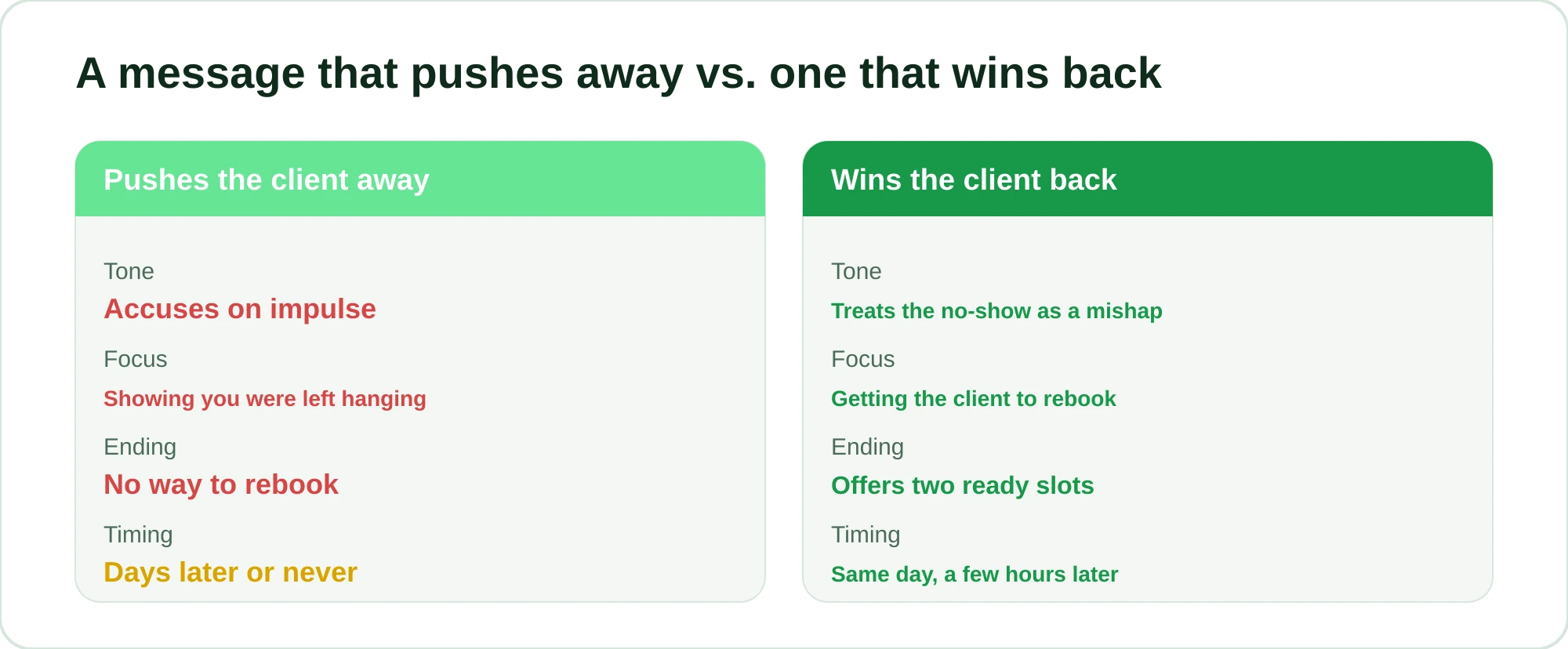
So what separates the message that wins the client back from the one that drives them off? Basically this:
- It doesn't accuse. No-shows happen. They forgot, got held up at work, something came up at home. Treating it like a crime pushes away a client who might have come back.
- It reopens the door: every message ends with an easy way to rebook. That's goal number one: getting the client to book again.
- It shows the schedule has an owner. You can be kind and firm at the same time. Mentioning your cancellation policy without drama teaches the client without scaring them off.
A note on timing: send it the same day, a few hours after the missed slot. Waiting three days lets the moment go cold, and the client barely remembers missing it.
5 ready-to-use messages for a client who missed their appointment
Use them as a starting point and adjust the tone to the way you talk to your clients. Barbershops tend to be more relaxed, salons sometimes more formal. You know your crowd.
1. The first no-show, with no deposit policy
For a good client who has never missed before, when you don't take deposits. Here the focus is simply to rebook and take any weight off the situation.
Hi, [Name]! We missed you today at 3 pm 😊 I'm guessing something came up. Want me to set aside a new slot for you this week? I have Thursday at 2 pm or Friday at 10 am. Just let me know which works better.
Why it works: it treats the absence as something unexpected, not a character flaw, and it offers two concrete times right away, which cuts down on the "I'll check and get back to you" that never comes back.
2. The client who missed and goes quiet (no reply)
You sent the first one and got no answer. Don't push again the same day. Wait a day or two and change the angle.
[Name], just a quick check-in. Your [service] appointment is still open and I want to make sure you don't miss out. If you'd like, just send me the day that works for you and I'll fit you in. I'm holding a good slot for you 👍
If there's still no reply, this client has probably cooled off for another reason. It's worth handling them in a separate win-back flow. See the templates in Client win-back messages: 10 templates for clients who disappeared.
3. The repeat offender (missed more than once)
Here you need to be firm, but without closing the door. The idea is to set a rule so your schedule isn't left hanging.
Hi, [Name]! I noticed today's slot ended up empty. No problem, we'll rebook. Just so you know: since it's been hard to make the times work, next time I'll confirm with you the day before and ask for a small deposit to hold the booking. That way the slot is locked in for both of us. Does that work for you? When would you like to come back?
Why it works: you present the new rule as something that helps both sides, not as a punishment. A client who values your work will be fine with it. The one who isn't, honestly, frees up space for someone who respects the time.
4. The client who paid a deposit and didn't show
If you already take deposits, the conversation changes. Money is involved and the message has to be clear about the policy, while still being warm.
[Name], how are you? You weren't able to make it to today's 4 pm appointment. As we agreed when you booked, the [amount] deposit is kept because of the no-show without notice. But let's sort out what's best for you: want me to rebook you for this week? If you can let me know 24 hours ahead next time, your deposit always counts as credit toward the service. Just tell me the day 😉
Taking a deposit is exactly what cuts down on this kind of headache. If you don't take one yet and you're not sure it's worth it, see how to charge appointment deposits without losing clients and check your local consumer rules.
5. The firm message to apply the policy (last resort)
For the client who takes advantage: always misses, never replies, and still complains when you charge. Here you set the limit politely.
Hi, [Name]. You missed today's appointment without notice, and it wasn't the first time. I really do love having you in, but to keep going I'll need future bookings to be secured with a deposit when you book. It's how I keep the schedule fair for everyone. If that works for you, just message me and I'll book you in. Take care!
This message isn't for everyone. It's for the few cases where keeping the client as things stand costs more than losing them. And notice: it still leaves the door open, just with a rule.
Quick table: which message to use in each case
| Situation | Tone | Main goal |
|---|---|---|
| First no-show, good client | Light, warm | Rebook right away |
| Missed and not replying | Calm, second attempt | Reopen the conversation |
| Repeat offender | Firm and kind | Introduce confirmation/deposit |
| Paid a deposit and missed | Clear about the rule | Apply the policy + rebook |
| Repeated abuse | Firm, with a limit | Set conditions for future bookings |
Having the template is easy. The work is sending them one by one
Having the templates ready solves half the problem. The other half is the legwork: remembering who missed, opening WhatsApp, finding the name, copying the text, tweaking it, sending it. On a busy Saturday, nobody does that. And the empty slots stay empty.
This is where RobotiZap takes the weight off your shoulders. It's a virtual assistant on WhatsApp that runs your barbershop or salon schedule 24 hours a day, on the official WhatsApp API (without the ban risk of a regular number). In practice, for the no-show problem, it handles this on its own:
- Sends automatic reminders and asks for attendance confirmation before the appointment. A lot of no-shows are just forgetfulness. The reminder alone prevents plenty of them, in many cases bringing the number of no-shows down considerably.
- Collects a deposit through an online payment link (card) at the time of booking. You don't have to bring up the awkward money conversation. People who've paid show up.
- Reopens rescheduling on WhatsApp when the client replies, without you typing anything. The client picks a new time just by chatting, in free text or even by voice note, in AI mode.
The client doesn't download any app or create an account. They message on WhatsApp like they would a friend, and the assistant takes care of it. You decide whether it works through a menu (step-by-step mode) or by chatting like a person.
Want to shut down no-shows for good? The complete step-by-step is in How to reduce no-shows at your salon or barbershop: the complete guide. And it's worth starting with the basics: a good appointment confirmation message stops the no-show from happening in the first place.
What it costs to stop losing slots to no-shows
RobotiZap has a single plan, with unlimited bookings and professionals. Every slot you recover is a chair that earns again, the automatic reminder prevents no-shows before they happen, and you save the hours you'd spend answering WhatsApp messages.
And you can start a free trial, with no long-term contract. You run it with your real schedule for the week and watch the reminders work before you spend anything.
Start your RobotiZap free trial
Frequently asked questions
Should I charge a client who missed their appointment?
It depends on your policy. If you agreed on a deposit at booking, it's fair to keep it when the client doesn't show without notice, as long as that was clear from the start. If you don't take deposits, a good client's first no-show usually isn't worth charging for: the focus should be on rebooking. Charging works better as a rule for repeat offenders than as a punishment for a first absence. Check your local consumer rules before you set your policy.
When should I send the message to a no-show?
The same day, a few hours after the missed slot. Waiting too long lets it go cold, and the client barely remembers the appointment. If they don't reply, wait a day or two before the second attempt, and shift the tone a little so it doesn't come across as a demand.
How do I keep the client from missing next time?
The combination that works best is an automatic reminder asking for confirmation the day before, plus a deposit at booking. The reminder solves forgetfulness (the biggest cause of no-shows) and the deposit filters out people with no real intention of showing up. Tools like RobotiZap do both automatically on WhatsApp.
Will the client be upset if I keep the deposit after a no-show?
When the rule was explained at the time of booking, clients rarely mind: they knew the deal. The problem comes when the charge is a surprise. So make your policy clear up front, and when a no-show happens, offer the option of using the deposit as credit toward a future appointment. That turns the conversation into a solution, not friction.
Is it worth keeping ready-made messages saved on my phone?
Yes, very much. Having templates saved keeps you from reacting on impulse (which tends to come out rude) and keeps your service consistent. But if you have high volume, copying and pasting one by one becomes a bottleneck on a busy day. In that case, automating the reminder and the rescheduling saves far more time than keeping a file of texts.