

How to Organize Your Beauty Salon Schedule
How to organize your salon schedule and stop squeezing people in by eye
Knowing how to organize your salon schedule really starts to matter on a Saturday at 10 am: the 9:30 blowout ran late because the client's hair was thicker than it looked. The 10:00 color is already sitting there waiting, the nail tech is free and nobody told anyone, and the phone rings with someone who wants "a quick cut right now". That's the moment your salon schedule decides whether Saturday pays off or runs behind all day.
The mess almost never comes from a lack of clients. It comes from three things nobody really teaches you to control: services that take very different amounts of time, several professionals each working at their own pace, and those three rush hours when everyone wants a slot at once. Sort out those three and your schedule stops running on panic.
Why the salon schedule turns into a mess
A salon isn't like a clinic where every appointment takes exactly 30 minutes. Your front desk juggles things that take 20 minutes and things that take four hours:
- Women's cut: 40 to 60 minutes
- Blowout: 30 to 50 minutes, depending on length
- Color or highlights: 2 to 4 hours, sometimes with processing time in the middle
- Manicure and pedicure: 40 to 90 minutes
- Keratin treatment: the whole morning
When you write everything in one notebook as just "9 am Maria", the duration disappears. So you slot a cut right after highlights thinking there's time, the chair stays tied up, and the next client waits standing at reception. Multiply that by three professionals and your whole Saturday is running late by 11 in the morning.
The problem isn't that you're disorganized. It's that no human head can work out how five services fit across three schedules while blow-drying someone's hair.
Start with the real duration of each service
Before you touch any tool, do one simple thing: list your services and time how long each one really takes in your salon. Not the tutorial time, your team's time on a normal day.
Also note the idle time. With color, there's a processing window when the stylist is free. That gap is gold: you can fit in a quick blowout or another client's manicure right in the middle. Anyone who organizes the schedule only by start times throws that time away.
A reference table helps you stop guessing:
| Service | Average duration | Free processing time |
|---|---|---|
| Women's cut | 50 min | — |
| Blowout | 40 min | — |
| Color | 2h30 | ~40 min of processing |
| Highlights / balayage | 3h30 | ~50 min of processing |
| Manicure | 50 min | — |
The numbers above are examples to work from, not a rule. Measure your own. With the right duration recorded, anyone at the front desk can book without asking you "is there time?".
One schedule per professional, not one schedule for the salon
This is where half the confusion lives. Many salons try to run everything on a single list and then try to remember who does what. The stylist who does color doesn't do nails. The nail tech doesn't do blowouts. If the schedule doesn't separate that, you end up booking highlights with someone who doesn't work with chemical services.
The right way is for each professional to have their own schedule, with their own services and their own hours. That way the system only offers the client what that person actually does, at the times they're actually in the salon. If Ana starts at noon on Wednesdays, nobody books Ana at 9 am.
It also settles the fight over chairs. Two clients can be seen at the same time, as long as it's by different professionals, and the schedule shows that side by side without you having to cross-check anything in your head. If you split commission by professional, separate schedules also make the month-end payout easier. I cover that in how to calculate hair stylist commission, step by step.
Setting this up properly has a few details worth a guide of their own: scheduling for multiple professionals on one calendar.
Take control of rush hour
Every salon has its rush. It's usually late afternoon on weekdays and all day Saturday. That's when the schedule fills up, runs late and creates a line. A few decisions change the picture a lot:
- Save the long blocks for the right times. A keratin treatment or highlights first thing in the morning, when the salon is calm, runs late less often than one squeezed into the middle of Saturday. Leave the rush for quick, high-turnover services like cuts and blowouts.
- Make processing time work for you. During the rush, that chemical-processing window is where you fit the quick blowout that makes a difference at the register.
- Stop accepting "come on over and we'll figure it out". The verbal squeeze-in is what blows up the schedule. If the slot isn't on the schedule, it doesn't exist.
- Keep a waitlist. When someone cancels at the last minute, a rush-hour slot can't sit empty. Automatically notifying whoever is waiting fills the gap before it costs you.
In the end, organizing the rush is about putting each service at the time it gets in the way the least.
Get booking out of your head (and off the phone)
Even with all that set, one bottleneck remains: someone has to answer, check the schedule and book. And that someone usually has their hands in a client's hair. Messages come in all day, many after hours, and every "what's open tomorrow?" pulls your attention away from the client in the chair.
This is where moving your schedule to WhatsApp takes that weight off the front desk. RobotiZap is an assistant that answers, shows each professional's open slots and books the appointment on its own, 24 hours a day, right on WhatsApp. The client doesn't download an app or create an account: she sends a message like she would to anyone, picks the service, sees who's available and confirms.
Because it already knows how long each service takes and each professional's schedule, the wrong booking can't happen: you can't book highlights with the nail tech or stack two services on the same chair. It works in two modes: step-by-step, with a guided menu, or with conversational AI, which understands clients writing in their own words and even by voice note ("hi, I'd like to get my nails done Saturday afternoon").
Fight no-shows, the gap no schedule can fill on its own
You can have the best-built schedule in the world and still lose money to people who book and don't show up. In a salon it hurts more than in a barbershop, because a color appointment that falls through takes two or three hours of chair time with it.
Two things cut this down a lot:
- Automatic reminders. A message the day before asking for confirmation gets a lot of clients to cancel ahead of time instead of simply vanishing. And you can pass that freed-up slot on to the waitlist.
- A deposit up front. For long, expensive services, taking a deposit through an online payment link (card) at the time of booking keeps away the clients who were going to flake. People who've paid show up.
RobotiZap sends the reminders, asks for confirmation and collects the deposit automatically, without you having to remember anything. In many cases that removes a good share of the no-shows that leave holes in your Saturday today. The reduction varies from salon to salon, but the effect of asking for confirmation and a deposit is consistent.
A step-by-step plan to organize your schedule this week
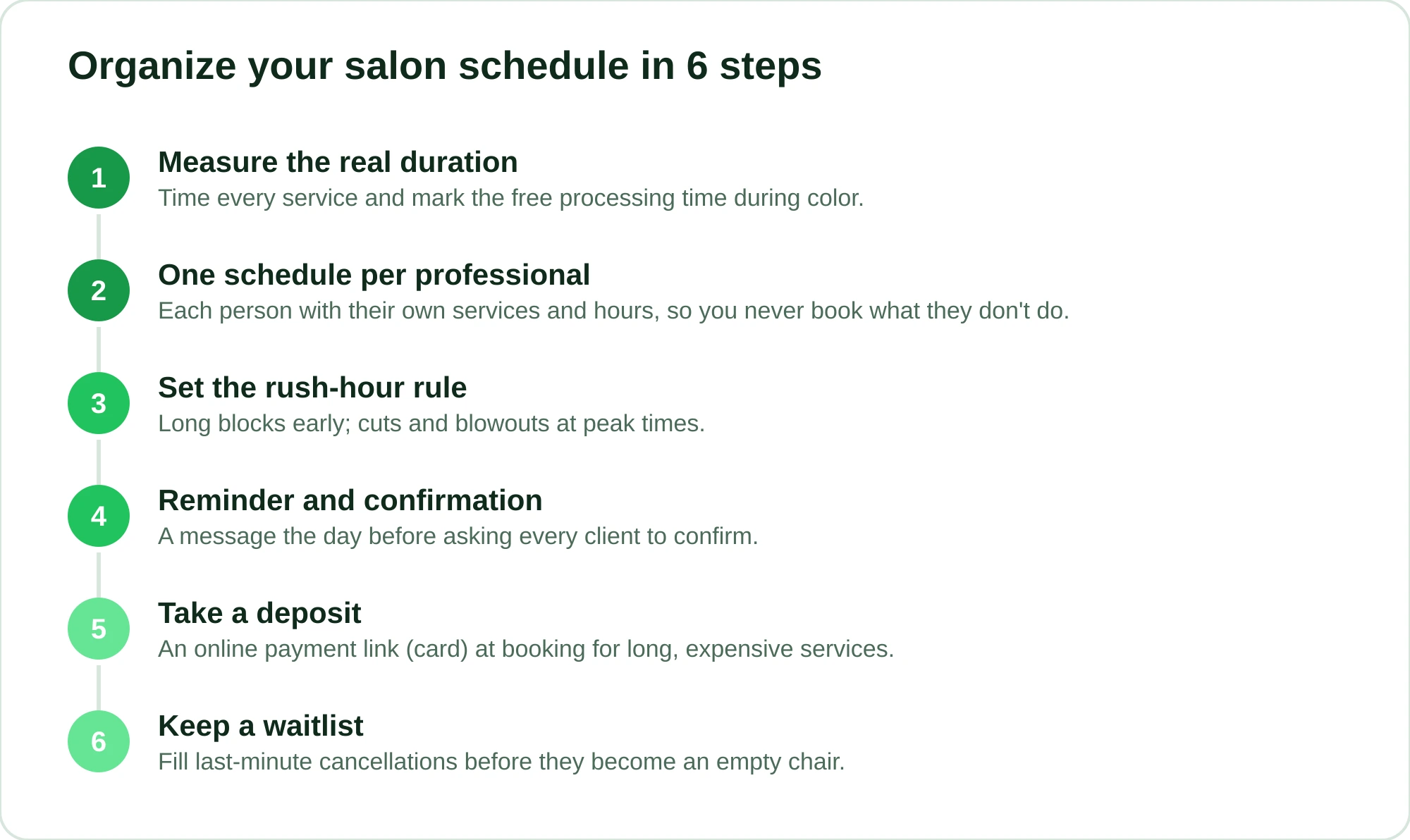
If you want to get off the notebook today, follow this order:
- List your services with their real duration and mark where there's free processing time.
- Create one schedule per professional with each person's services and hours.
- Set your rush-hour rule: long blocks early, quick services at peak times.
- Turn on reminders and confirmation for every booking.
- Take a deposit on long, expensive services.
- Keep a waitlist so a cancellation doesn't turn into an empty chair.
Do these six steps and your schedule stops running on improvisation. If you want to compare the tools that can handle all of this, read what to look for in the best salon booking software.
What it costs to do this right
RobotiZap has a single plan, with unlimited bookings and professionals and no long-term contract. Look at it from your front desk: every color appointment that used to fall through and now stays filled is revenue you keep. Add the hours you and your front desk stop spending answering "any openings tomorrow?", plus the AI that's already included at no extra cost. That money was leaking out of the register; now it stays.
Before you pay anything, you can try it free. You set up your professionals' schedules, configure the durations and watch the assistant book appointments before you spend a cent.
Start your RobotiZap free trial
Frequently asked questions
How do I organize a salon schedule with services of different lengths?
Record the real duration of each service, including the free processing time during color. With the right duration in the system, bookings respect each chair's time and you stop putting a quick cut on top of four-hour highlights.
How do I avoid two clients booked at the same time?
Keep a separate schedule for each professional, each with their own services and hours. That way, two appointments at the same time only happen with different professionals, and the system never offers a slot that's already taken for the same person.
Can I organize my salon schedule entirely through WhatsApp?
Yes. With RobotiZap, clients book, reschedule and confirm on WhatsApp without downloading an app or creating an account. The assistant shows each professional's open slots and books the appointment on its own, even in the middle of the night and on days the salon is closed.
How do I handle rush hour without leaving people waiting on their feet?
Save long services for the quieter hours, leave the rush for cuts and blowouts, and never accept verbal squeeze-ins. Keep a waitlist to fill last-minute cancellations without leaving the chair empty.
Does taking a deposit scare clients away?
Generally, it doesn't put off people who really want the slot, and it does keep away the ones who were going to miss it. For long, expensive services, a deposit through an online payment link (card) at the time of booking cuts no-shows a lot without getting in the way of clients who are genuinely committed to their appointment.