

How to Calculate Hair Stylist Commission, Step by Step
How to calculate hair stylist commission without arguing at the end of the month
Payday arrives: your stylist does the math in her head, you do yours in the notebook, and the numbers don't match. Knowing how to calculate hair stylist commission clearly settles half of those arguments before they even start. The other half goes away when you put everything in writing and use the same method every month.
There are four things to sort out: what goes into the base, which percentage to use, commission vs. booth rent, and the math done step by step.
What goes into the commission base
Before the percentage, you need to decide which amount the commission is calculated on. This is the point that causes the most confusion.
The most common bases are:
- Full service price. Commission comes out of the price the client paid for the blowout, cut, color and so on.
- Net amount. You first subtract the cost of supplies (color, developer, disposables) and calculate commission on what's left.
- Full price minus card fees. Common in salons where card processing takes a noticeable bite out of the till.
Any of these bases works. What causes trouble is changing the base mid-month without telling anyone. If you agreed on commission over the net amount, subtract supplies first and show the math. A stylist who can see where every number came from trusts you more and questions you less.
One detail a lot of owners forget: retail products are not services. Selling a professional shampoo at the front desk usually carries a different commission rate (normally lower) than doing a color service. Treat the two separately from the start.
Commission percentages you'll see in salons
The percentage depends on who covers what. The more the salon provides (space, products, marketing, front desk), the smaller the stylist's share tends to be. The more the stylist brings her own clients and supplies, the bigger her share.
Ranges you'll often hear (rules of thumb, not fixed rules):
| Situation | Commission range for the stylist |
|---|---|
| Salon provides everything (space, products, clients) | 30% to 40% |
| Salon provides space and clients, stylist covers some supplies | 40% to 50% |
| Stylist brings her own clients and some supplies | 50% to 60% |
| Retail sales at the front desk | 5% to 15% |
These numbers vary a lot by country, city, salon level and how hard it is to hire good stylists. Where skilled stylists are in short supply, their share goes up. Use the table as a starting point for the conversation, not as law.
Commission vs. booth rent: which makes more sense
There are two main pay models, and they work in opposite ways.
How commission works
With commission, the stylist earns a percentage of every service. If she brings in little that month, she earns little; if her book is full, she earns more. The risk is shared: the salon and the stylist go up and down together.
Upside for you: in a slow month, your payroll shrinks too. You don't pay for an empty chair. Downside: in a strong month, you split a bigger pie.
How booth rent works
With booth rent (also called chair rental), the stylist pays a fixed amount for the space, weekly or monthly, and keeps everything she brings in. The salon becomes something like a landlord for the workstation.
Upside for you: predictable income. The same amount comes in no matter how busy she is. Downside: if the chair sits empty, that's the stylist's problem, but a salon full of idle chairs and frustrated stylists becomes your problem in the medium term.
How each model is treated for employment and tax purposes depends on where you operate, so check your local rules before you set it up.
Comparing them in practice
Picture a stylist who brings in $8,000 a month (illustrative figures).
- 40% commission: she takes $3,200 and the salon keeps $4,800 (and covers products, front desk and the electric bill).
- Booth rent of $1,200 a month: the salon gets a fixed $1,200, she takes $6,800 and pays for her own supplies.
If the same stylist brought in only $3,000 that month, the math changes: with commission you split a small pie ($1,200 for her, $1,800 for you), and with booth rent you still get your fixed $1,200. Each model protects you in a different scenario. Salons with established stylists who have their own clients often move to booth rent; salons still building their client base usually stay with commission.
You don't have to pick one model for everyone. It's common to have the nail tech renting a booth and the stylists on commission, or the other way around. What can't happen is each person believing they're on a different model than the one you think they're on.
Step by step: calculating the commission
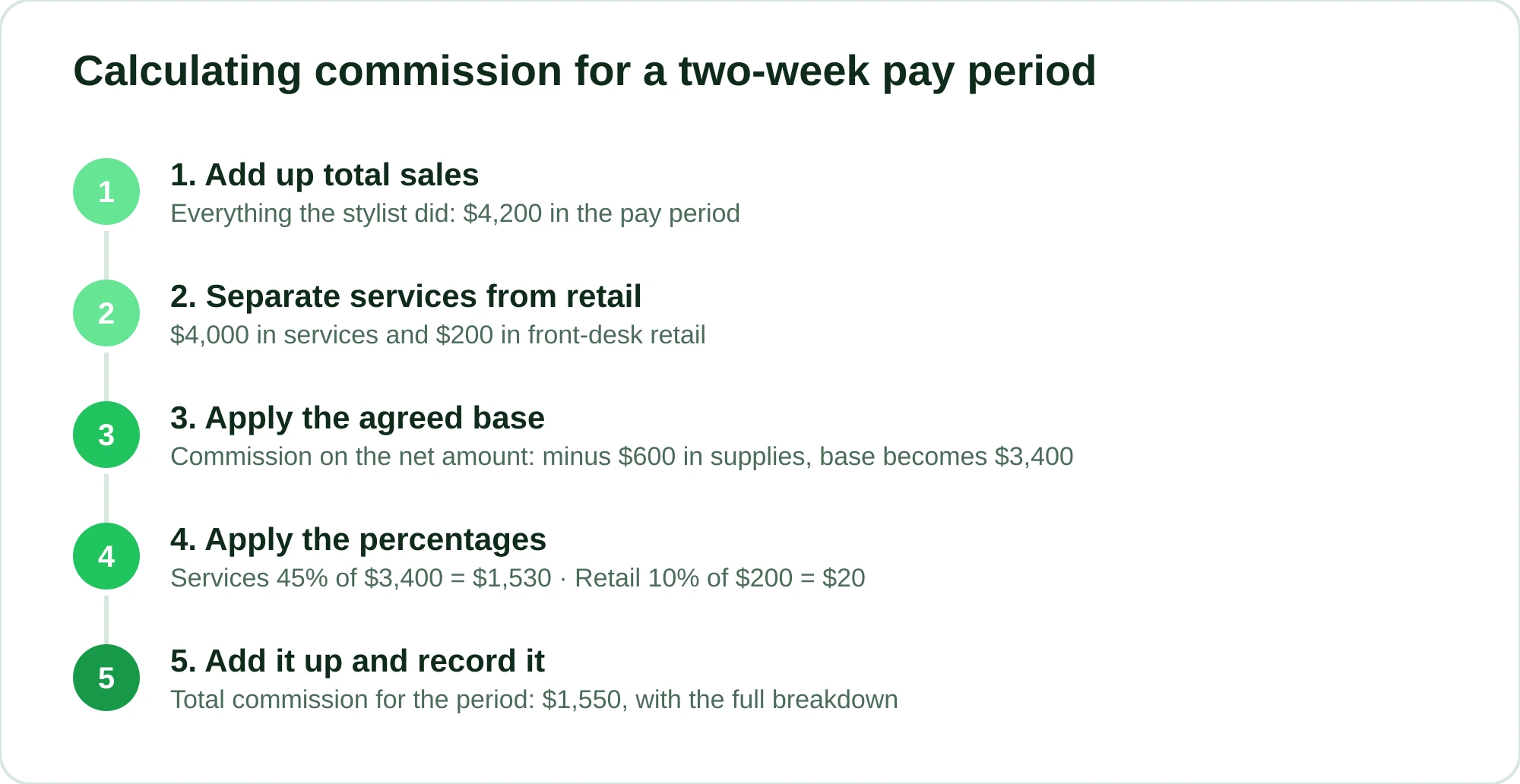
Let's build the full calculation, the way it looks at the end of the day.
Step 1: Add up the stylist's sales for the period. Everything she did: cuts, blowouts, color, treatments. For example: $4,200 in a two-week pay period.
Step 2: Separate services from retail. Say $4,000 in services and $200 in products sold at the front desk. The percentages are different, so don't mix them.
Step 3: Apply the agreed base. If commission is on the net amount and supplies for those services cost $600, the service base becomes $3,400.
Step 4: Apply the percentages.
- Services: 45% of $3,400 = $1,530
- Retail: 10% of $200 = $20
Step 5: Add it up and record it. Total commission for the period: $1,550. Write down the whole calculation, not just the result. When the stylist can redo the number on her own, she checks it herself and there's nothing left to question.
Example with card fees
If you subtract card processing fees before commission, include that in Step 3. On $4,000 in services with an average 3% fee, you take out $120 before applying the percentage. Just remember to agree on this beforehand, never after the work is done.
Where the math usually gets stuck (and how to avoid it)
The calculation itself is simple. What makes it complicated is the record-keeping. The most common stumbles:
- A service that never got written down. A cut here, a blowout there, and by the end of the month someone's total is short.
- A verbal discount. The stylist charged a friend $50 for a $70 service. Which amount does commission apply to? Decide that beforehand.
- Prepaid packages. The client bought 5 blowouts upfront. Does commission count at the sale or on each blowout used? There's no single right answer, but there has to be an agreed answer.
- Two professionals on one service. One does the color, another does the finish. You need a clear rule for splitting the commission.
Almost all of these problems share the same root: the service isn't recorded at the time, linked to the right professional. If your schedule already ties together "who did it, which service, how much it cost", calculating commission stops being a treasure hunt through the notebook. It's also worth reading How to Organize Your Beauty Salon Schedule, because when the schedule is a mess, the commission almost always comes out wrong too.
How to automate commission calculations
Doing this by hand every pay period, with 4 or 5 professionals, is where most errors creep in. A system that records every service already linked to the professional takes care of the tedious part: it adds everything up on its own.
In RobotiZap, each professional has their own schedule, and services are recorded with the name of whoever performed them. Commission can be set up in three ways:
- Global: one default percentage for that professional's services.
- Per service: color pays one percentage, cuts pay another.
- Per product: front-desk retail has its own percentage.
Since booking happens on WhatsApp and every service is already tied to the right professional, closing the period no longer depends on memory and paper. If you work with several professionals, the post Scheduling for Multiple Professionals: One Calendar, No Mix-Ups shows how this works day to day, with independent schedules that don't overlap.
RobotiZap is a WhatsApp assistant that books appointments on its own, 24 hours a day, using the official WhatsApp API (the company is a Meta-certified Tech Provider, which reduces the risk of getting banned). Clients book on WhatsApp with no app to download and no sign-up, and they choose their stylist. You close commissions with the math already done. RobotiZap has a single plan, with unlimited bookings and professionals, and you can start with a free trial.
Think it through: the spreadsheet hours you stop spending every pay period, plus the commission mistakes that disappear from payday, add up fast. And that's before counting fewer no-shows thanks to automatic reminders, which refill slots that would otherwise sit empty.
If you want to compare options before deciding, see Best Salon Booking Software: What to Look For. And if you'd rather test it with your own schedule, just create your free RobotiZap account and run a real pay period.
Frequently asked questions
What's the most common hair stylist commission percentage?
It depends on who covers what. When the salon provides the space, products and clients, the stylist's share usually falls between 30% and 40%. When the stylist brings her own clients and some supplies, it rises to the 50% to 60% range. Front-desk retail pays much less, usually between 5% and 15%. These are rules of thumb that vary by market, not fixed values.
Is commission calculated on the full price or the net amount?
Both models exist. With the full price, you apply the percentage to what the client paid. With the net amount, you first subtract the cost of supplies (and sometimes card fees) and calculate commission on what's left. What matters is agreeing on the base in writing and never changing it mid-month.
Booth rent or commission: which is better?
Commission shares the risk: in a slow month your payroll shrinks too, and in a strong month you split a bigger pie. Booth rent gives you predictable income, but you don't share in it when the stylist has a great month. Salons still building their clientele tend to prefer commission; established stylists with their own clients tend to move to booth rent. You can use different models for different people in the same salon. How each model is treated for tax and employment depends on your location, so check your local rules.
How do I pay commission on products sold in the salon?
Treat retail separately from services. Set a specific percentage for products (usually lower than for services) and record each sale linked to the professional who made it. Systems like RobotiZap let you set commission per product apart from commission per service, so the math comes out right without mixing the two.
Do I need a system to calculate commission, or can I do it by hand?
With one stylist and a handful of services, a notebook holds up. Once you have three or four professionals, different percentages per service and retail sales, manual calculation becomes a source of mistakes and friction on payday. A system that records every service linked to the professional adds everything up on its own and shows the full breakdown, so there's nothing to dispute at the end of the month.